Family Reunification: Residence Permits for the Foreign National's Family
Family reunification is the provision of the Immigration Law that allows a family member of a Brazilian citizen or an immigrant already authorized to reside in Brazil to obtain their own residence permit. It applies to spouses, partners, children, stepchildren, parents, grandparents, grandchildren, siblings, and persons under guardianship, conservatorship, or custody. The application is submitted to the Federal Police, along with documentation proving the family relationship.
When a multinational company transfers an executive to Brazil, the professional’s visa solves only half the problem. The other half is the family. Spouses, school-age children, and, in some cases, elderly parents need their own legal status to remain in the country, enroll in school, open a bank account, and work. Without this legal framework, the move comes to a halt shortly after arrival.
This guide explains what family reunification is, who is eligible for it, what documents support each type of family relationship, how the process is handled by the Federal Police, and which mistakes are most likely to jeopardize the application. The goal is to provide global mobility managers and expatriates themselves with a clear roadmap.
What is family reunification under the Immigration Act?
Family reunification is a right of migrants, expressly provided for in Brazilian law. It exists to prevent international mobility from separating families. In practice, it transforms family ties into a legal basis for residency.
A Law No. 13,445/2017, the Immigration Act guarantees migrants, on an equal footing with nationals, the right to family reunification with their spouse or partner, children, relatives, and dependents. The procedure is governed by the Interministerial Ordinance No. 12, dated June 14, 2018, published by the Ministries of Justice and Public Safety and of Foreign Affairs.
It is worth noting an important distinction. The family reunification visa is neither a type of work visa nor an ancillary benefit of an expatriate visa. It is a standalone residence permit, with its own requirements, granted to a family member based on their relationship with someone already in Brazil.
Who is the family member making the request, and who is the beneficiary?
The sponsoring family member is the person who is already legally residing in Brazil and serves as the basis for the application. This person may be a native-born or naturalized Brazilian, or an immigrant who already holds a residence permit. The beneficiary is the foreign family member who wishes to reside in the country based on this family relationship.
This relationship determines almost everything in the process. The granting of a residence permit to the family member is contingent upon the prior granting of a residence permit to the sponsor, although both applications may be submitted simultaneously. When the sponsor is Brazilian, the family member’s residence permit is typically granted for an indefinite period. When the sponsor is an immigrant with a fixed-term residence permit, the family member’s permit generally matches the sponsor’s in duration, with the possibility of renewal.
Is a family reunion considered a visa or a residence permit?
It can be either one, and the difference lies in where the person is located. If the family member is still abroad, the process involves applying for a temporary visa for family reunification at a Brazilian consular office. This visa is valid for up to one year, and the immigrant must register with the Federal Police within ninety days of entering the country.
If the family member is already in Brazil, the process involves applying for a residence permit directly at a Federal Police office. Many expatriate families use this alternative route: the spouse and children enter the country and formalize the application later, along with the principal applicant’s registration. This option requires careful attention to the authorized length of stay granted upon entry, so that the application is filed before it expires.
Who is eligible to apply for a residence permit based on family reunification?
The list of accepted family relationships is broad and extends far beyond just a couple. It covers the family structure in three directions: sideways, downward, and upward. According to the official website of the Ministry of Justice and Public Security on residence permit, family reunification authorization is granted to immigrants in the following cases.
| Bond with the family member who called | Who is reached |
| Spouse or partner, without any discrimination whatsoever | Marriage and domestic partnerships recognized under Brazilian law |
| Child of a Brazilian or of an immigrant with permanent residency | Children of the already authorized holder |
| Stepson of a Brazilian or of an immigrant with permanent residency | Stepchildren, based on age and dependency criteria (see below) |
| Anyone with a Brazilian child | Father or mother of a child born in Brazil |
| People who have immigrant children who are eligible for residency | Parent of a child who has already been authorized |
| Ascendant up to the second degree | Parents and grandparents |
| Descendant up to the second degree | Children and grandchildren |
| Brother of a Brazilian citizen or an immigrant with permanent residency | Siblings, based on age and dependency |
| Anyone who has a Brazilian citizen under guardianship, conservatorship, or custody | Legal guardian of a Brazilian citizen |
Do spouses and partners qualify under the same conditions?
Yes. The law treats spouses and partners without any discrimination, in accordance with the Brazilian legal system. This means that formal marriage and a proven common-law marriage have the same immigration consequences, and that the rule applies to same-sex couples.
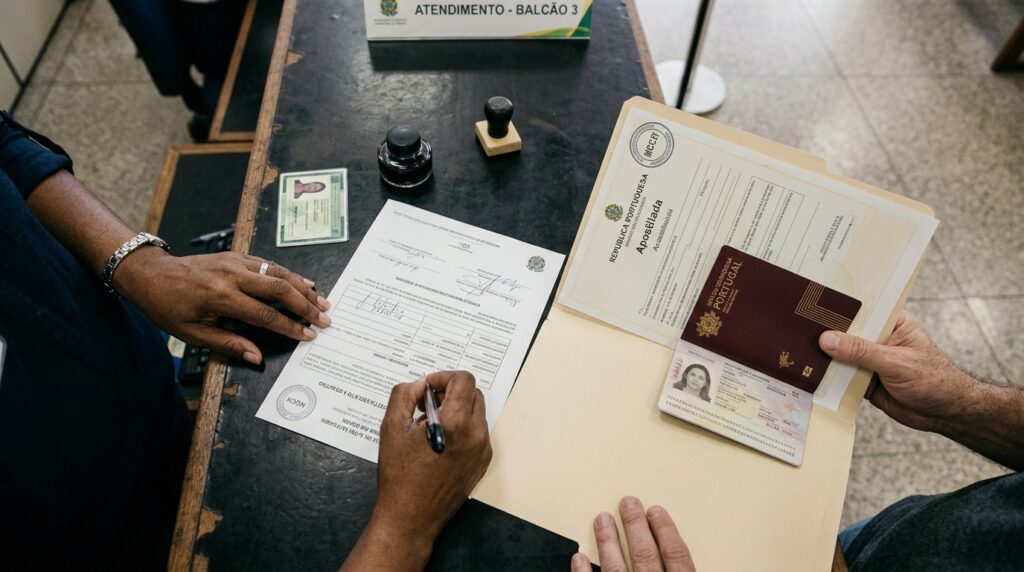
The difference lies in the proof. Marriage is proven by a marriage certificate, which must be apostilled and translated if issued abroad. A common-law marriage can be proven by a certificate or similar document from the civil registry. If it is not possible to present such a document, the law allows for other means of proof, such as a sworn statement under penalty of law by two people attesting to the existence of the union, a real estate deed listing the parties as owners, or a lease agreement naming both parties. International couples who have never formalized their relationship in their country of origin must prepare this body of evidence in advance.
Stepchildren and children: What exactly is the rule?
Children of Brazilian citizens or authorized immigrants fall directly under the legal provision, regardless of age. The key document is the birth certificate, which must unequivocally establish parentage. When the child’s travel document does not include parentage information, the birth certificate or consular certificate becomes essential.
The stepson, contrary to what many people assume, has its own specific provision set forth in the statute. It does not depend on guardianship, custody, or conservatorship to qualify. The criterion is objective and operates in three stages:
- A person under the age of eighteen: direct framing.
- Up to twenty-four years: provided that the applicant is a verified student.
- Any age: provided that financial dependence on the family member making the request is proven.
This detail is particularly important in blended families, which are common among corporate expatriates. A common mistake is to try to fit the stepchild into the custody or guardianship framework—which is designed for a different situation—when the law itself already provides a direct and simpler solution.
Can parents, grandparents, and siblings be included?
Yes, they can. Ascendants and descendants up to the second degree are eligible, which includes parents, grandparents, children, and grandchildren. Siblings of Brazilian citizens or immigrants with permanent residency are also expressly eligible, and the eligibility criteria mirror those for stepchildren: under eighteen years of age, or up to twenty-four if they are a verified student, or of any age upon proof of financial dependence.
In applications for a residence permit filed in Brazil, this is precisely the documentation requirement that most often causes delays. In the case of a sibling over the age of eighteen, proof of financial dependence on the sponsor must be submitted. Upon renewal, the continued existence of this dependency must be confirmed by a sworn statement.
What documents are required when applying for family reunification?
The documentation for the family reunion application is organized into three sections: the applicant’s identity, proof of the family relationship, and the status of the family member in Brazil. The application is processed by the Federal Police, and the absence of any required document typically results in the process being halted pending its submission.
Documents typically required when applying for a residence permit for family reunification:
- The applicant's travel document or official identification document
- Two 3×4 photos
- Birth certificate, marriage certificate, or consular certificate, when the travel document does not include parentage information
- Completed application form
- Proof of payment of the fees for the residence permit and for the issuance of the National Migration Registration Card, when applicable
- Criminal background checks from the countries where the applicant has resided in the past five years
- Declaration, under penalty of law, that I have no criminal record in any country during the past five years
- Document proving the family relationship between the applicant and the family member who invited them
- Identification document of the Brazilian citizen or immigrant with whom the applicant wishes to be reunited
- Declaration, under penalty of law, that the family member making the request resides in Brazil
- Proof of financial dependence, in the case of a sibling over the age of eighteen
Why do apostille certification and certified translations hold up so many legal proceedings?
Because almost all documents proving a relationship come from abroad. A marriage certificate issued in Germany, a birth certificate issued in Japan, and a criminal record issued in India are not automatically valid in Brazil. They must go through the legalization process.
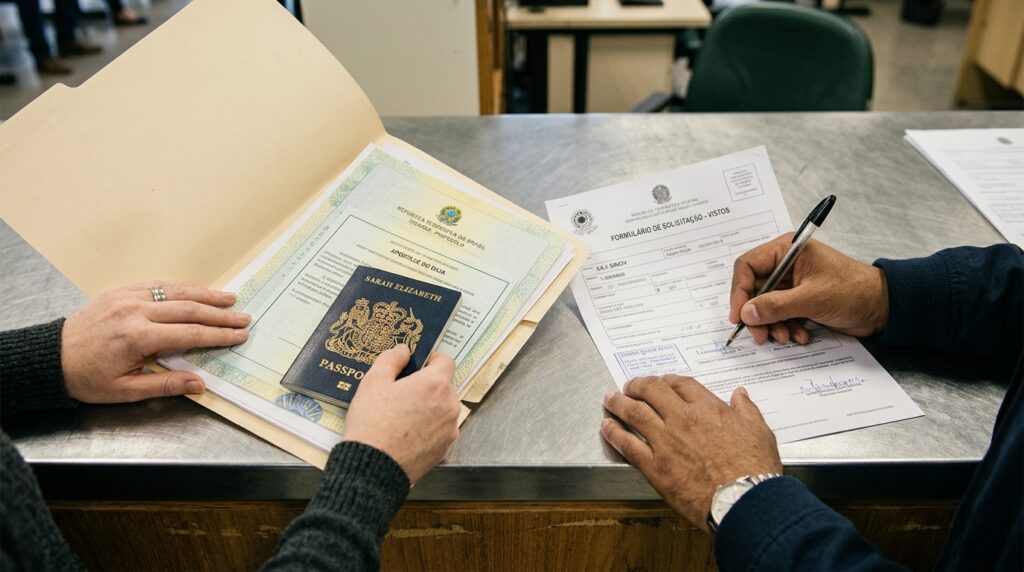
Documents issued in a country that is a signatory to the Hague Apostille Convention must be apostilled at the country of origin. Documents from non-signatory countries must undergo consular legalization. After that, a certified translation by a licensed translator in Brazil completes the process. This sequence of steps is the most time-consuming part of the family reunification timeline. In cases handled by consulting firms such as Target Relocation, it is addressed as part of the documentation, apostille, and certified translation, initiated at the same time as the account holder's request and never after it.
Criminal history: where and when?
The rule requires certificates from the countries where the applicant has resided in the past five years, not just from the country of nationality. An Indian executive who lived in Singapore for three years before coming to Brazil will have to submit both an Indian certificate and a Singaporean certificate.
This detail often goes unnoticed. Families with a history of international relocation—which is precisely the typical profile of a corporate expatriate—end up discovering this requirement too late. Compiling a list of residences over the past five years should be the first step in the process, before gathering any documents.
How does the process work, step by step, and how long does it take?
The family reunification process involves document submission, review, and immigration registration. It is conducted by the Federal Police, in accordance with the regulations of the Ministry of Justice and Public Security. Understanding the sequence of steps helps avoid rework.
Step-by-step guide to placing an order in Brazil:
- Identify the relationship and determine which legal category the family member falls under
- List the countries of residence for the past five years and request criminal background checks
- Have foreign documents apostilled or legalized at their country of origin and arrange for a certified translation
- Fill out the application form and pay the applicable fees
- File the application at the Federal Police station in the applicant's city of residence, along with all required documentation
- Monitor any requirements and respond to requests for additional information
- Complete the registration process and pick up your National Immigration Registration Card after your application is approved
How long does it take to get approval for family reunification?
According to the official service itself, the estimated processing time ranges from 130 to 180 calendar days, depending on the type and complexity of the request. This timeframe does not include the time required beforehand for collecting, apostilling, and translating foreign documents, which is usually the longest part of the actual timeline.
Therefore, proper planning for an international relocation involves two distinct phases. The first is the documentation phase, which depends on notary offices and foreign authorities, and the second is the administrative phase, which depends on the review process in Brazil. Ignoring the first phase is the most common mistake made by those who promise the family a specific moving date.
What happens if the application is placed on hold or denied?
Most of the problems aren’t rejections; they’re requests for additional information. The process is put on hold while waiting for a missing document, a translation that wasn’t certified, or an expired certificate. Responding quickly to these requests is what keeps the schedule on track.
The denial of an application usually results from insufficient proof of the employment relationship or a requirement that has not been met—situations that can often be corrected through further investigation. It is worth noting that the regulations allow for investigative measures aimed at proving the family relationship, including in-person interviews, without prejudice to the applicant’s right to propose other forms of evidence. The key issue is to prevent the family member from remaining in an irregular immigration status while the case drags on. Maintaining a valid period of stay and filing the application within the correct timeframe is part of the strategy, not merely an operational detail.
How do family gatherings factor into corporate travel planning?
Companies that transfer employees to Brazil treat the employee’s visa as the priority and the family as an afterthought. This reversal of priorities is costly. An executive who arrives without a spouse who can work and without children who can enroll in school tends to end the assignment early.
The holder of a residence permit for family reunification may engage in any activity in the country, including paid work, on an equal footing with Brazilian nationals, in accordance with current legislation. This is one of the most important aspects of the expatriation package, because it opens up career opportunities for the accompanying spouse and directly reduces the risk of early return.
A mobility checklist that usually works:
- Map out the entire family unit before setting the transfer date
- Begin the apostille and translation process at the same time as the principal applicant's process; never afterward
- Align your children's school calendar with the estimated timeline for the immigration process
- Prioritize the school over the neighborhood, because housing is organized around it
- Find out if your spouse plans to work and what that entails in terms of registration
- Provide for renewal and deadlines when the sponsor is an immigrant with temporary residency
Target Relocation, which serves more than 70 multinational companies and has been providing corporate immigration services since 2001, manages this process by treating the principal applicant and dependents as a single project, with a single document checklist and ongoing support until each family member receives their National Immigration Registration Card.
In practice, the next step is finding a home. The school you choose defines the area, and the area defines the property. The technical criteria for this decision are detailed in the guide on House Hunting for Foreigners in Brazil, including the requirement to have an active CPF before registering with a real estate agency.
Frequently Asked Questions About Family Reunions
What is a family reunion in Brazil?
Family reunification is the legal basis that allows a family member of a Brazilian citizen or an immigrant with a residence permit to obtain their own residence permit in the country. It is provided for in the Migration Law and regulated by Interministerial Ordinance No. 12/2018. It applies to spouses, partners, children, stepchildren, parents, grandparents, grandchildren, siblings, and persons under guardianship, conservatorship, or custody. The application is submitted to the Federal Police, along with documents proving the family relationship.
Does the stepson attend the family meeting?
They qualify automatically under the provisions of the law, without needing a guardian or legal custody. The criteria are age and dependency: a stepchild under eighteen qualifies automatically; up to twenty-four, if proven to be a student; and of any age, if financial dependency on the inviting family member is proven. This is a crucial point for blended families relocating internationally.
Can a spouse who has been granted residency through family reunification work?
Yes. A holder of a residence permit for family reunification may engage in any activity in the country, including paid work, on an equal footing with Brazilian nationals, in accordance with current legislation. In practice, this allows the accompanying spouse to resume their career in Brazil, a decisive factor in the family’s ability to remain in the country for the duration of the assignment.
How long does the family reunification process take?
The estimated processing time provided by the official service ranges from 130 to 180 calendar days, depending on the type and complexity of the application. To this timeframe must be added the time required for collecting, apostilling, and having documents issued abroad certified by a sworn translator—a process that often takes several more weeks than the administrative review in Brazil itself.
What is the difference between family reunification and naturalization?
Family reunification grants residency based on family ties, while maintaining the person’s status as a resident alien. The Brazilian naturalization It is the next step and transforms a resident into a citizen. Those who have a Brazilian spouse or partner may even have the residency requirement reduced when applying for naturalization, which links the two issues in long-term planning.
Does a common-law marriage count toward a family reunion?
Fair enough. The law treats spouses and partners without any discrimination, in accordance with the Brazilian legal system, which includes proven common-law marriages. The preferred form of proof is a civil registry certificate. If it is not possible to present this, the law allows for other means, such as a sworn statement by two people, a deed for jointly owned property, or a lease agreement in which both parties are named.
Conclusion
Family reunification is the mechanism that prevents international mobility from leading to family separation. It covers a wide range of relationships—from spouses to stepchildren who are students—and grants the beneficiary independent residency status, with the right to engage in paid work on an equal footing with nationals.
What determines the success of the application is not its legal complexity. It is the organization of the documentation. Apostilled foreign certificates, valid certified translations, criminal records from all countries of residence over the past five years, and solid proof of the relationship form the backbone of a smooth application process.
For the company that transfers an employee and for the family that crosses the ocean with him, family reunification is less of a formality and more of a prerequisite for success. It paves the way, but it doesn’t travel that path alone: housing must be arranged, and the family’s belongings must arrive within the customs window, as shown in the guide on International Moving and Freight Transport. When these three areas are addressed from the very first day of the project—rather than treated as add-ons to the project owner’s approval—change ceases to be a risk and becomes a plan.