Celpe-Bras for naturalization: what foreigners need to know
Celpe-Bras for naturalization is one of the official tests of whether a foreigner can communicate in Portuguese. This command of the language is a mandatory requirement for ordinary naturalization. The ability to communicate in Portuguese is a prerequisite for being considered Brazilian, and proof by documents is mandatory. GOV.BR
Many foreign professionals live in Brazil for years without knowing that citizenship requires this stage. The doubt usually arises late, at the end of the residency process. Resolving this at the wrong time delays the application and generates document rework.
This article explains what the exam is, how it relates to Brazilian citizenship, who is exempt from it and what alternatives the Ministry of Justice accepts. The idea is to give the reader a clear map before starting the process.
What is Celpe-Bras and why does it matter for citizenship?
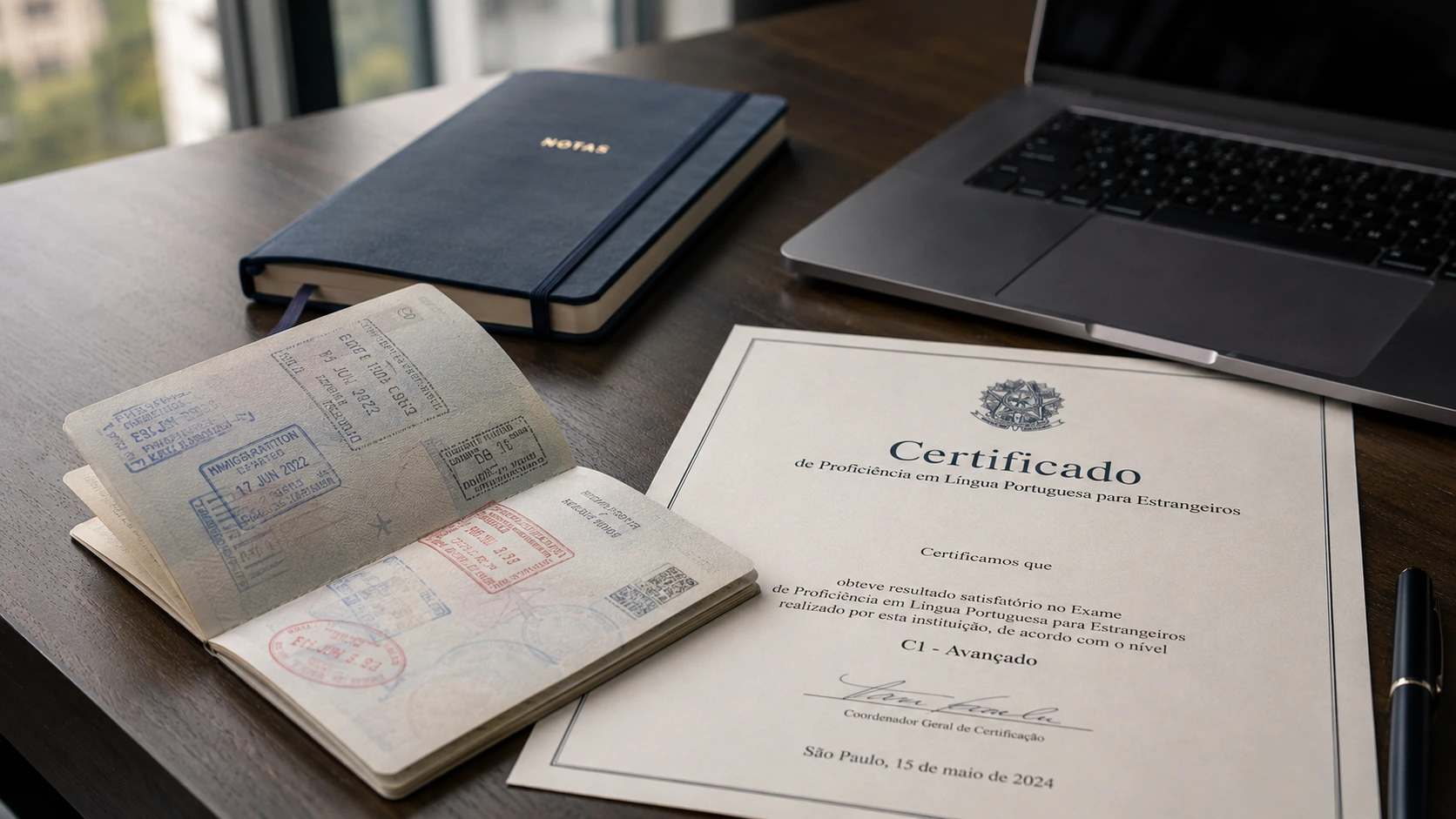
Celpe-Bras is the official Brazilian exam for proficiency in Portuguese as a foreign language. It is administered by the Instituto Nacional de Estudos e Pesquisas Educacionais Anísio Teixeira, or Inep, and is used by foreigners to prove their fluency in the language. www
The acronym stands for Certificate of Proficiency in Portuguese for Foreigners. The exam is the country's official procedure for this purpose. The tests are taken at testing centers such as universities, diplomatic representations and cultural centers. www
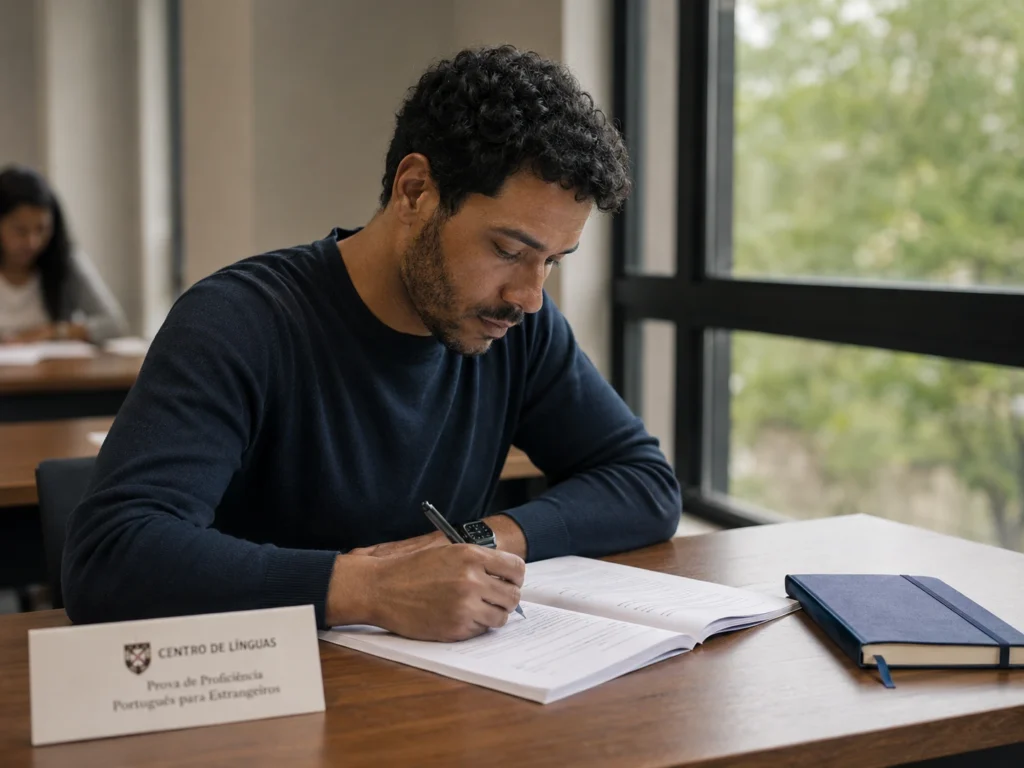
The exam assesses the actual use of the language, not just grammar rules. It has two parts:
- Written part: up to three hours, with four text production tasks.
- Oral part: a face-to-face interaction of around 20 minutes with evaluators.
To better understand the structure and purpose of the exam, it is worth consulting the Inep's official Celpe-Bras page. It is the primary source on format, ranks and application rules.
How does Celpe-Bras connect to Brazilian naturalization?
The connection is direct: the certificate is one of the ways of proving the Portuguese required to become Brazilian. The documents accepted to prove communication in Portuguese are listed in Article 5 of Ordinance No. 623 of November 13, 2020. GOV.BR
Ordinary naturalization is the most common route for foreigners living and working in Brazil. It requires legal residence for a minimum period, no criminal convictions and proof of language skills. Those who want to understand the full process can follow the content on Brazilian naturalization and its modalities.
Celpe-Bras is usually the most recognized because it is the official government exam. But it's not the only one, as we'll see below.
Who has to prove their Portuguese?
Not all foreigners need to take the exam. The requirement applies to those whose first language is not Portuguese.
Applicants from Portuguese-speaking countries such as Angola, Cape Verde, Guinea-Bissau, Mozambique, Portugal, São Tomé and Príncipe and East Timor do not need to prove their ability to communicate in Portuguese. The exemption is based on the Federal Constitution. Therefore, the first step is to check your nationality of origin before planning the exam. GOV.BR
What documents can prove your Portuguese besides the Celpe-Bras?
Celpe-Bras is not the only test accepted. Since 2018, the government has expanded the alternatives to reduce bureaucracy. Before this change, Portuguese could only be proven by Celpe-Bras; today there are other ways provided for by ordinance. Justice
The choice of document depends on the foreigner's background. See the main options accepted:
| Form of proof | When it usually applies |
|---|---|
| Celpe-Bras Certificate (Inep) | Foreigners without a Brazilian diploma |
| Higher or post-graduate diploma in Brazil | Those who studied at an institution accredited by MEC |
| Passing the OAB Bar Exam | Legal professionals |
| Portuguese course for immigrants at a recognized institution | Those who have taken a course aimed at foreigners |
Ordinance No. 623 lists these documents as indicative of the applicant's ability to communicate in Portuguese. The important detail is that each document has its own validity and legalization requirements. BR-Visa
When and how does Celpe-Bras registration work?
The exam follows a calendar defined by Inep, with editions throughout the year. The dates change with each edition, so consulting the current notice is mandatory.
As a reference for the recent cycle, the second annual edition followed this pattern:
- Registration: opened in August, through the Celpe-Bras System.
- Application of tests: in October, at the applicator stations.
- Results: released in December.
In the most recent edition, registration was open until August 15, the exams took place between October 21 and 24 and the results came out on December 17. This interval between exams and results is strategic for those who have a deadline for residency. The official dates for each edition can be found at Celpe-Bras news page on Inep. www
How to plan the proof of Portuguese in a corporate process?
For companies transferring executives to Brazil, language comes early in the planning. The ideal is to map out the form of proof at the beginning, not at the end of the residency process.
The critical point is timing. A certificate that takes months to be issued can put the brakes on the naturalization application if it is left to the last stage. Anticipating the decision avoids this bottleneck.
In processes carried out by consultancies such as Target Relocation, proof of Portuguese is included in the documentary checklist along with criminal records, proof of residence and translations. Target Relocation, which has been involved in corporate immigration for more than two decades and has worked with more than 70 multinationals, usually structures this stage in phases. This way, the expatriate and the company know in advance which document to use and when to request it.
Frequently asked questions about Celpe-Bras for naturalization
Is Celpe-Bras compulsory for naturalization? Not exactly. What is required is proof of the ability to communicate in Portuguese. Celpe-Bras is one of the ways of doing this, and the most recognized. Those who have a degree in Brazil or have passed the OAB, for example, can use these documents instead of the exam.
Do people from Portuguese-speaking countries need to take the Celpe-Bras? No. Foreigners from Portuguese-speaking countries, such as Portugal, Angola and Mozambique, are exempt from having to prove their Portuguese when they are naturalized. This exemption has a constitutional basis. In these cases, the effort should be focused on the other requirements, such as length of residence and documentation.
How long does the Celpe-Bras certificate take to come out? It depends on the timing of the edition. In the recent cycle, the exam was held in October and the results came out in mid-December. For this reason, those with tight deadlines should apply early. The interval between registration, exam and results can be more than four months.
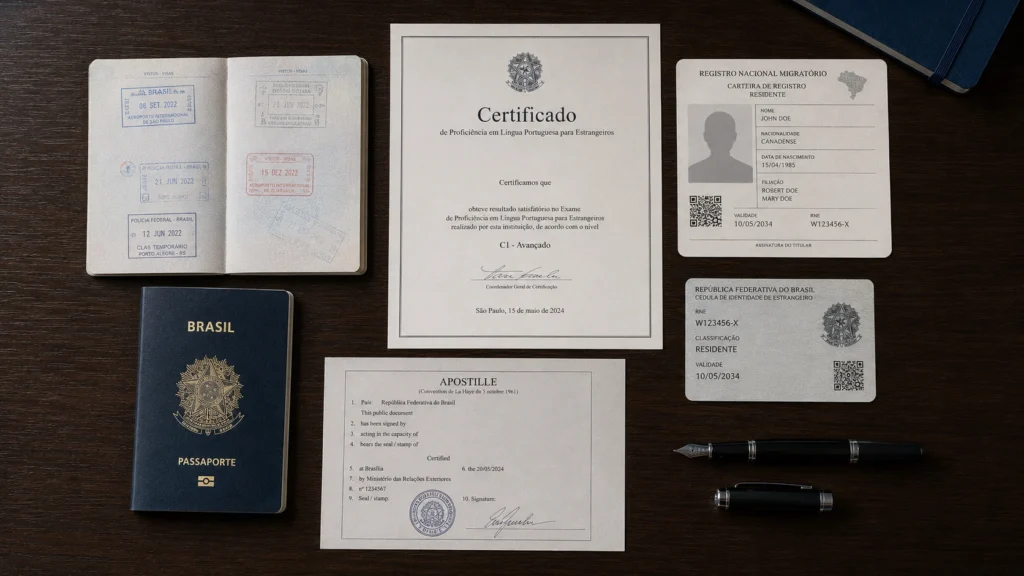
What is the difference between the Celpe-Bras and other Portuguese exams? Celpe-Bras is an exam designed specifically to measure proficiency. Other documents, such as a Brazilian diploma or the Bar Exam, serve as indirect proof. All are accepted by Ordinance No. 623, but each requires its own legalization and validity. Foreign documents usually require sworn translation and apostille.
Is it worth taking the Celpe-Bras even if you have a Brazilian diploma? In general, this is not necessary. If you have a degree or post-graduate diploma from an institution accredited by the MEC, it can be used as proof. Celpe-Bras is more useful for those who didn't study in Brazil and need an official document of proficiency.
Conclusion
Celpe-Bras is the most widely recognized gateway to proving Portuguese for naturalization. But it's not the only one, and not every foreigner needs to take it. Those who come from Portuguese-speaking countries are exempt, and those who have a Brazilian diploma can use it instead of the exam.
The key thing is to treat the language test as part of a longer journey. Brazilian citizenship is the end of a journey of legal residence which, for many professionals, begins with a specific work permit, such as the technical visa (RN 03). Language is just one part of this journey.
Understanding this sequence in advance changes the outcome. The foreigner who maps out documents, deadlines and waivers at the beginning will achieve naturalization without any surprises. What seems like a bureaucratic detail is, in practice, what separates a smooth process from a stuck application.