
The documents that a Brazilian expatriate takes from Brazil to Venezuela include a valid passport, a criminal background check, birth and marriage certificates, diplomas, and a letter from the company. Civil and academic documents must be accompanied by a Hague Apostille and a certified translation into Spanish. Start the process 90 days before your trip.
Updated on · Content reviewed by the corporate immigration team at Target Relocation.
Key Points
- Documents for Venezuela are divided into identification and travel documents, civil and academic documents, and business documents.
- Certificates, criminal records, and diplomas issued in Brazil must be accompanied by an Apostille under the Hague Convention, to which Brazil and Venezuela are parties.
- After the apostille is issued, the certified translation into Spanish covers both the document and the apostille certificate.
- The validity period is determined by the Venezuelan agency; therefore, documents with a short validity period must be issued close to the date of the request.
- A 90-day timeline reduces the risk of delays in the move.
Also known as: Checklist for moving to Venezuela, documentation for expatriates, and documentation for residency in Venezuela.
If your company is transferring a Brazilian employee to Caracas or another Venezuelan city, the most manageable part of the process is gathering the necessary documents for Venezuela while still in Brazil. A document without an apostille, with a name discrepancy, or that has expired will hold up the residency application and delay the expatriate’s arrival.
This guide provides a checklist, the correct order for submitting documents and translations, the validity period for each item, and a timeline that begins 90 days before the trip. The final decision on what to accept rests with the Venezuelan government, so please confirm the list with the Venezuelan consulate and the destination company before issuing any documents.
What documents do Brazilians need to bring with them when traveling to Venezuela?
The Brazilian expatriate brings four types of documents from Brazil: identification documents, civil status certificates, academic transcripts, and company documents. These documents, when submitted to the Venezuelan authorities, form the basis of the visa and residency application.
| Document | What is it for? | Handout and translation |
|---|---|---|
| Brazilian passport | Identification and Travel | Do not add notes; check the required remaining validity period |
| Federal Police Criminal History Record | Verify the professional's background | In general, handouts and translations |
| Birth Certificate | Parentage and Civil Identity | In general, handouts and translations |
| Marriage Certificate | Relationship with a Spouse | In general, handouts and translations |
| Degrees and Transcripts | Verify professional qualifications | When required, a handout and a translation |
| Letter of Hire or Transfer | Provide proof of employment | It depends on where it is issued; please confirm |
The table shows the most common scenario. Since the final list is determined by the consulate and Venezuela’s immigration agency (SAIME, Servicio Administrativo de Identificación, Migración y Extranjería), request the official list in writing.

What is the Hague Apostille, and which documents require it?
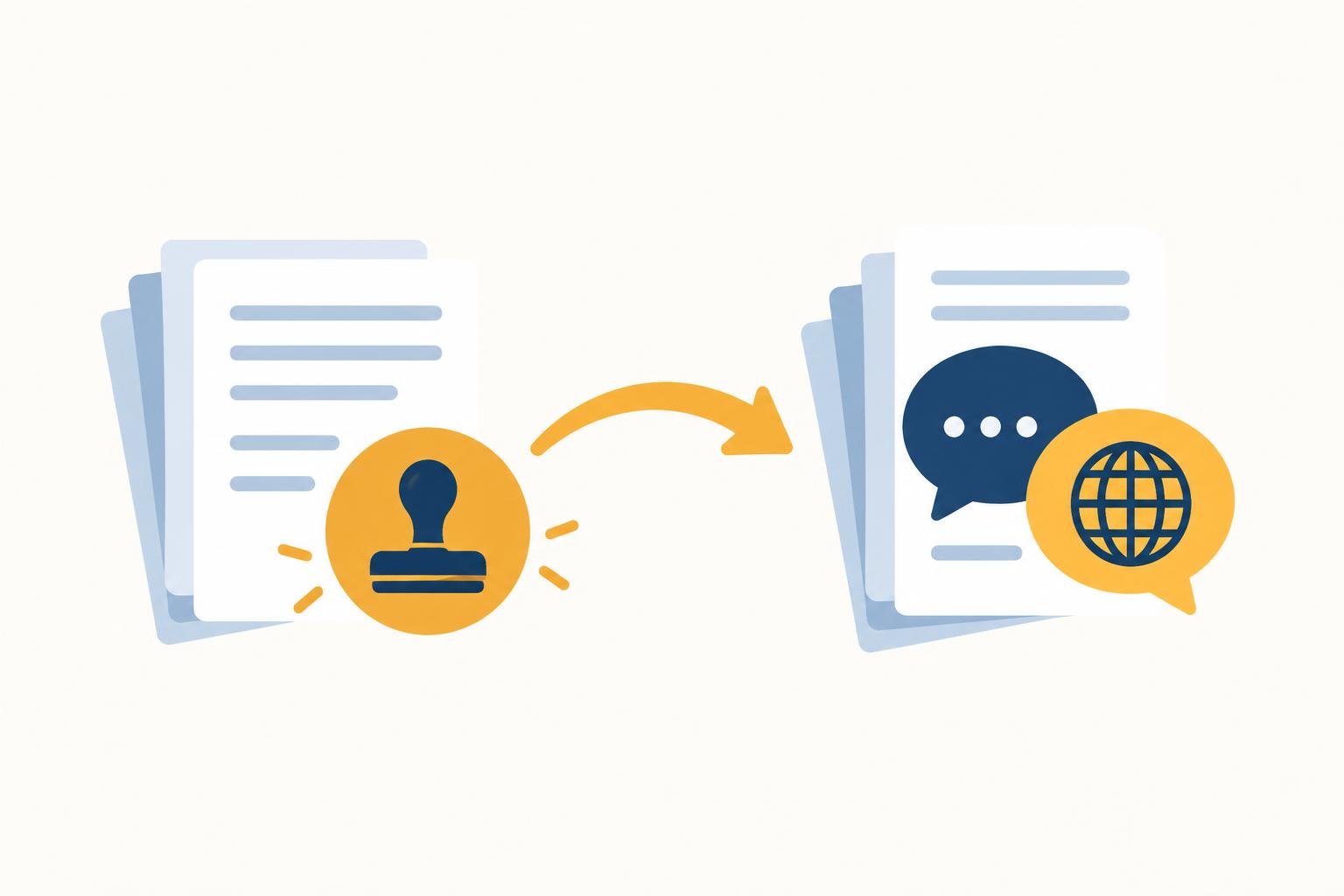
The Hague Apostille is a certificate that authenticates the origin of a public document and replaces consular legalization among the countries that are parties to the 1961 Hague Convention. Brazil enacted the convention through Decree No. 8,660/2016, and Venezuela is also a party to the treaty. In Brazil, notary offices issue the Apostille in accordance with Resolution No. 228/2016 of the National Council of Justice (CNJ).
As a general rule, birth and marriage certificates, criminal background checks, diplomas, and transcripts require an apostille. Private documents, such as a letter from a company, usually require notarization first. Among the documents required for Venezuela, civil documents are the ones that most often cause delays due to the lack of an apostille.
The step-by-step instructions are in the guide for Hague Apostille for Expatriates' Documents.
How does certified translation into Spanish work?
A certified translation is performed by a public translator and commercial interpreter—a professional with public authority who is registered with the state Board of Trade. For Spanish, you must hire a certified translator for that language. Many procedures follow this order: the document is first apostilled and then translated in its entirety, including the text of the apostille.
Check with the consulate to see if it accepts translations done in Brazil or if it requires a translator certified in Venezuela. This answer will affect the timeline for all documents intended for Venezuela. Also, ask the translator to ensure that the spelling of names matches exactly that on the passport.
To understand deadlines and precautions, see the information on Certified translation for immigration purposes.
How long are the documents valid for travel to Venezuela?
There is no single expiration date: the Venezuelan agency that receives the application determines the validity period, and the count generally begins on the date of issuance. The rule of thumb is to issue the document with the shortest expiration date as close as possible to the date of filing.
- Criminal history: They have a short validity period; issue them only after the other items have been processed.
- Birth and marriage certificates: They generally do not have an expiration date, but some agencies require a recent copy; it is best to request a new duplicate.
- Degrees and transcripts: They usually don't win, but the handout and translation must be complete and legible.
- Passport: Check with the consulate to confirm the minimum remaining validity period required, and renew it before then if it is nearing its expiration date.
Record the deadline for each item in a process spreadsheet. This precaution prevents you from having to redo documents for Venezuela that have expired while you were waiting.
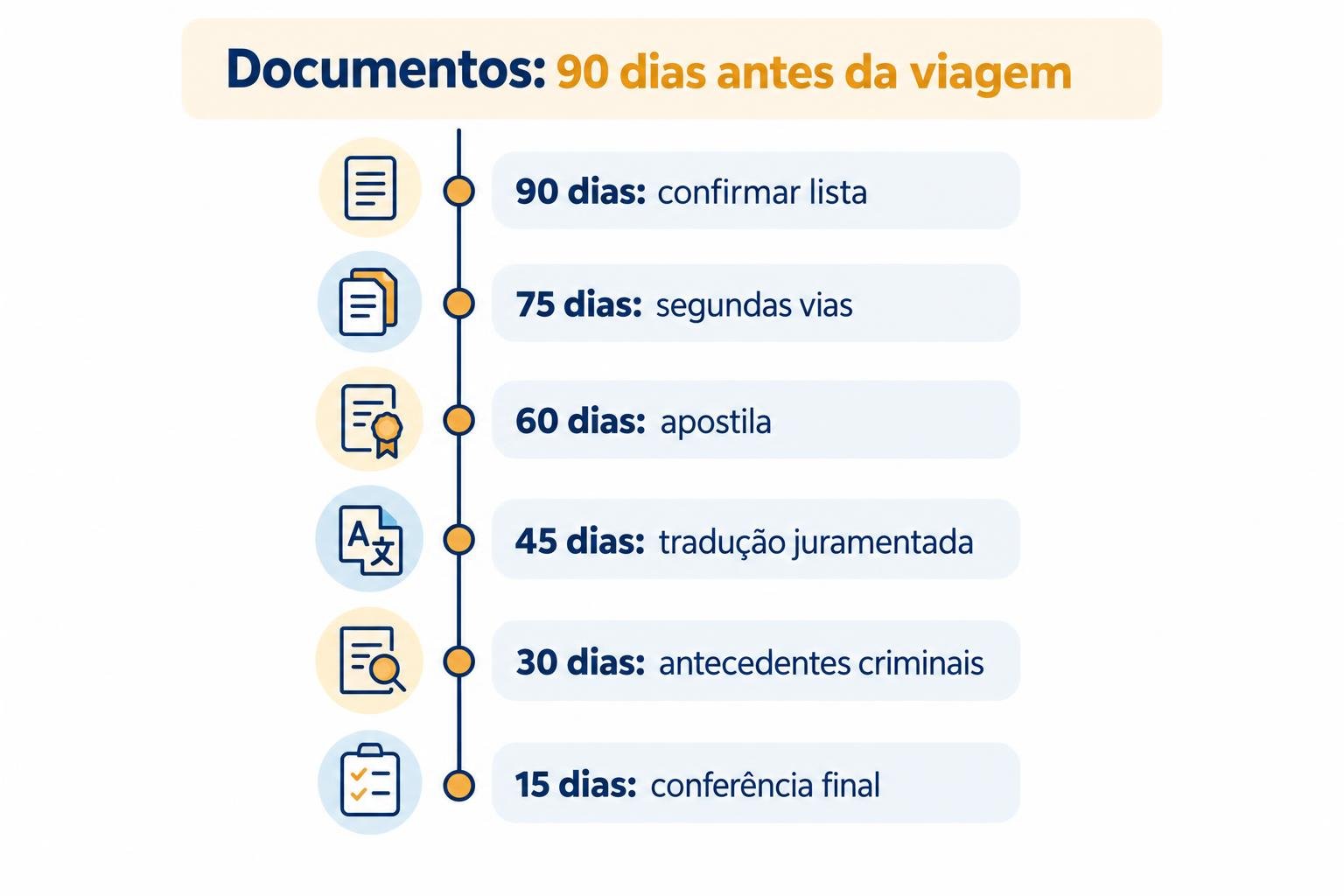
What is the 90-day timeline for gathering the documents for Venezuela?
The 90-day timeline is a practical guideline that organizes document collection, preparation, and translation in order and leaves documents with short validity periods for last. Notary and consulate processing times vary, so be sure to allow for some flexibility at each stage.
- 90 days before: Confirm the official list with the consulate and the receiving company, check your passport, and locate the original certificates.
- 75 days before: Request duplicate copies of birth and marriage certificates, diplomas, and transcripts.
- 60 days before: Have your signature notarized and obtain an apostille at a notary public's office.
- 45 days before: Have the apostilled documents officially translated.
- 30 days before: Issue the criminal record certificate, have it apostilled, and have it translated.
- 15 days before: Check the names, dates, and numbers, and scan everything.
- 7 days before: Put together the physical and digital folders and carry the originals in your carry-on luggage.
This document timeline for Venezuela works best when the company designates an in-house person to be responsible for the process.
What documents should I bring for my spouse and children?
Spouses and children must accompany the expatriate with apostilled and translated marriage and birth certificates, as well as their own passports. The family must follow the same documentation requirements as the professional for Venezuela, paying special attention to the spelling of names.
- Marriage certificate or proof of a common-law marriage, as applicable.
- Birth certificate for each child.
- Academic transcript and enrollment certificate, with a translation, for admission to the school at the destination.
- Vaccination record and health requirements for entry; please confirm with the consulate.
- Travel authorization from the other parent, if the minor is traveling without one of his or her parents, in accordance with Brazilian regulations.
If your last name changed after marriage, be sure to bring the certificate proving the change as well, so that the name on your passport matches the name on the certificates.
What else does the company need to provide besides the employee's documents?
The company needs to arrange the employment contract at the destination, handle the tax assessment for the employee’s departure, and manage the logistics of the move. These items supplement the documents for Venezuela that the employee gathers on his or her own.
- Letter of employment or transfer agreement, as required by Venezuelan law; this must be a Brazilian document with a notarized signature and an apostille.
- Corporate documents of the Venezuelan recipient company, typically handled by the local operation.
- Power of attorney for a professional or family member to resolve outstanding matters in Brazil, such as banking, real estate, and vehicles.
- Tax Residency Analysis: Temporary or Permanent Departure from Brazil Affects Obligations to the Federal Revenue Service.
- International relocation and, if applicable, pet transportation, which have their own health requirements.
HR saves time when it treats everything as a single mobility project. The expatriate management and relocation combines these items into a single schedule.
What are some common mistakes that cause delays in processing documents for Venezuela?
The mistakes that most often cause delays in processing documents for Venezuela are spelling errors, errors in the order of documents, and missed deadlines—all of which can be easily prevented.
- Name differs between passport, certificates, and diplomas.
- To certify a document that is not the original or a certified copy required by the notary public.
- Translate before obtaining an apostille, without checking with the consulate to see if the document is accepted.
- Forgot to translate the text from the handout.
- Issuing a criminal history record too early and letting it expire.
- Save the children's birth certificates for last.
- Traveling to Venezuela without digital copies of all documents.
A checklist that specifies who is responsible for each item and the due date prevents most of these delays.
Essential Information About Documents for Venezuela
| Item | Information |
|---|---|
| Decision-making body | The Venezuelan government, through the Venezuelan consulate and SAIME |
| Basis of the workbook | 1961 Hague Convention, enacted in Brazil by Decree No. 8,660/2016 |
| Who issues the certificate in Brazil? | Notary offices, pursuant to CNJ Resolution No. 228/2016 |
| Who needs it | Brazilian expatriates and their dependents who are moving to Venezuela |
| Key Documents | Passport, criminal record, certificates, diplomas, and a letter from the company |
| Translation | Certified translation into Spanish; confirm whether the consulate accepts translations done in Brazil |
| Typical timeframe | It varies depending on the notary office, translator, and consulate; it is recommended to start 90 days in advance |
| Cost | Fees according to the state registry office’s schedule; translation fees quoted by the translator; visa fees as determined by the Venezuelan consulate |
How Target Relocation Helps
Target Relocation is a Brazilian global mobility consulting firm that handles corporate immigration, documentation, and the relocation of professionals on international assignments. When it comes to documents for Venezuela, it helps organize the checklist, the timeline for apostille and translation, and coordination with the company and the family.
Frequently asked questions
Do Brazilians need a visa to live in Venezuela?
To live and work in Venezuela, Brazilian citizens must regularize their immigration status with the Venezuelan authorities—generally through the consulate before traveling and through SAIME after arrival. The type of visa depends on the nature of the relationship and the reason for the move. Check with the consulate for the list of required documents for Venezuela.
Does the passport need an apostille?
No. A passport is an identification and travel document issued by the Federal Police and does not require an apostille. Public documents used as proof—such as certificates, criminal records, and diplomas—do require an apostille. For your passport, simply check that it has the remaining validity period required by the consulate.
What is the difference between an Apostille and consular legalization?
Consular legalization requires a chain of authentications all the way to the consulate of the destination country. The Hague Apostille replaces this chain with a single certificate issued by a notary public in Brazil, which is valid among the countries that are parties to the Convention, such as Brazil and Venezuela. This reduces the number of steps and the processing time for documents destined for Venezuela.
Should the certified translation be done in Brazil or Venezuela?
It depends on the requirements of the Venezuelan agency. Many procedures in Brazil use a certified Spanish translator after the apostille is obtained. Some agencies may require a translation by a professional recognized in Venezuela. Check with the consulate before hiring a translator to avoid paying twice for the translation of documents intended for Venezuela.
How long does it take to gather the documents for Venezuela?
The processing time varies depending on the notary office, translator, and consulate. Obtaining duplicate certificates and translations are the most time-consuming steps, and the criminal background check should be left until last because it has a short validity period. That’s why it’s recommended to start 90 days before your trip, allowing for unforeseen circumstances.
Sources and Legal Basis
- The 1961 Hague Convention on the Apostille, enacted in Brazil by Decree No. 8,660/2016.
- Resolution No. 228/2016 of the National Council of Justice (CNJ), which regulates the issuance of apostilles by Brazilian notary offices.
- Consular Portal of the Ministry of Foreign Affairs, with information on visas and consular services.
- The Venezuelan Consulate and SAIME, which are responsible for the final visa and residency requirements in the country.
Are you going to transfer an employee to Venezuela? Get a free relocation assessment from Target Relocation and create a timeline for the professional and their family's documents.