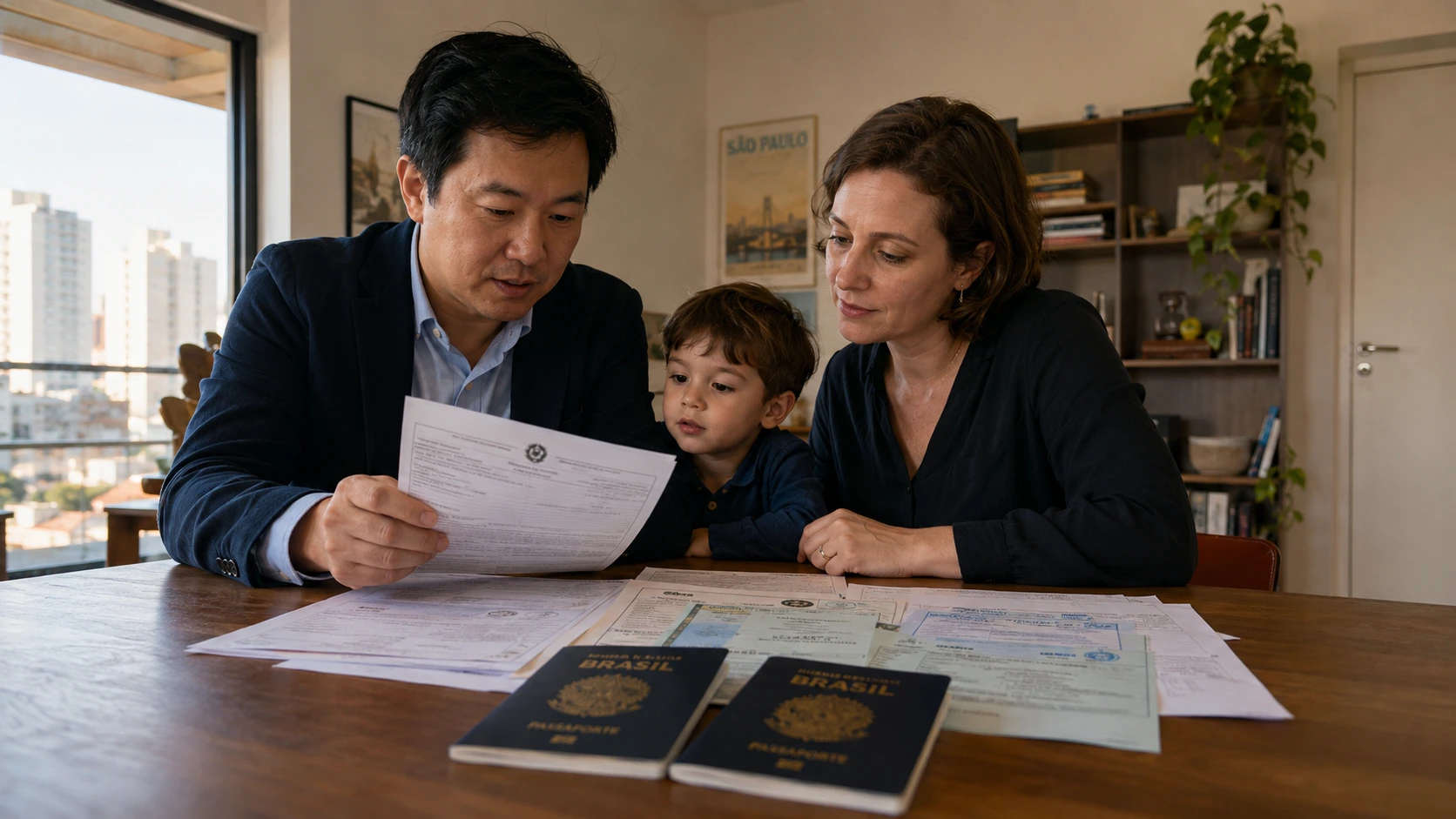
Family Reunification: How Foreign Nationals Obtain Residency Through Family Ties
A family reunification residence permit allows a foreign national to live legally in Brazil based on a family relationship with a Brazilian citizen or an immigrant already residing in the country. It covers spouses, partners, children, parents, siblings, and dependents.
This document addresses two common situations. The first is that of an expatriate who comes to work in the country and needs to bring their family. The second is that of a foreigner who has a direct relationship with a Brazilian, such as marriage or a common-law marriage. In both cases, the question is the same: what is the correct legal procedure, and what documents are required?.
This article explains what family reunification is, who is eligible, how the process works in both situations, and what the deadlines are. The goal is to provide clarity on each step before you begin the application.
What is a residence permit for family reunification?
Family reunification is a legal basis for residence provided for in the Immigration Act. It is based on a simple principle: families should be able to stay together in the same country.
The right to family reunification is guaranteed in Law No. 13,445 of 2017, the Migration Law, both in the principles of immigration policy and in the provision defining who is eligible. The law treats family ties as a basis for residency in their own right, without requiring a job offer or investment.
In practice, there is a key figure in the process: the sponsor. The sponsor is the person who already resides in Brazil, whether a Brazilian citizen or an immigrant with a residence permit. The family member to be brought over is the sponsored individual.
Who is eligible for family reunification?
The law lists the categories of family members who are eligible to receive benefits. They are:
- Spouse or partner, without discrimination of any kind, including common-law marriage.
- Son a resident immigrant, or a foreign national who has a Brazilian child or a resident immigrant child.
- An ascendant, a descendant up to the second degree, or a sibling a Brazilian citizen or a resident immigrant.
- A foreign national who has a Brazilian national under their guardianship, conservatorship, or custody.
Each category requires a specific document to prove the family relationship. Therefore, ensuring the correct classification from the outset prevents rework and rejection.
How does an expatriate bring their family to Brazil?
Expatriates who come to work usually enter the country on a work-based residence permit. Their dependents enter under the family reunification program, linked to that primary residence permit.
This is the most common scenario in corporate mobility. The professional first obtains their authorization, which is often tied to a technical position such as the technical visa RN 03. Next, the foreign spouse and children apply for residency on the basis of family reunification.
The rule of thumb here is that dependents’ residency status is tied to the validity of the expatriate’s authorization. If the expatriate’s residency is renewed, the family’s residency must also be updated.
In processes managed by consulting firms such as Target Relocation, which serves more than 70 multinational companies, this process is handled in parallel. As a result, the principal and their dependents arrive in Brazil with their immigration status already resolved and ready to settle into their new routine.

How does the process work for a foreign national with ties to a Brazilian citizen?
When the relationship is with a Brazilian citizen, the process depends on where the foreign national is located at the time of the application. There are two entry points.
The regulations governing this process are set forth in Interministerial Ordinance No. 12/2018, issued by the Ministry of Justice and the Ministry of Foreign Affairs. It outlines two options. If the foreign national is outside the country, they must apply for a temporary family reunification visa at a Brazilian consular office. If they are already in Brazil, they must apply for a residence permit directly at a Federal Police office.
This is the category that includes common-law marriages. The partner of a Brazilian citizen has the same rights as a spouse, provided they can prove the relationship with valid documentation. Common-law marriages are subject to their own rules regarding proof of the relationship and deserve a separate chapter.
What documents are required for the family reunion?
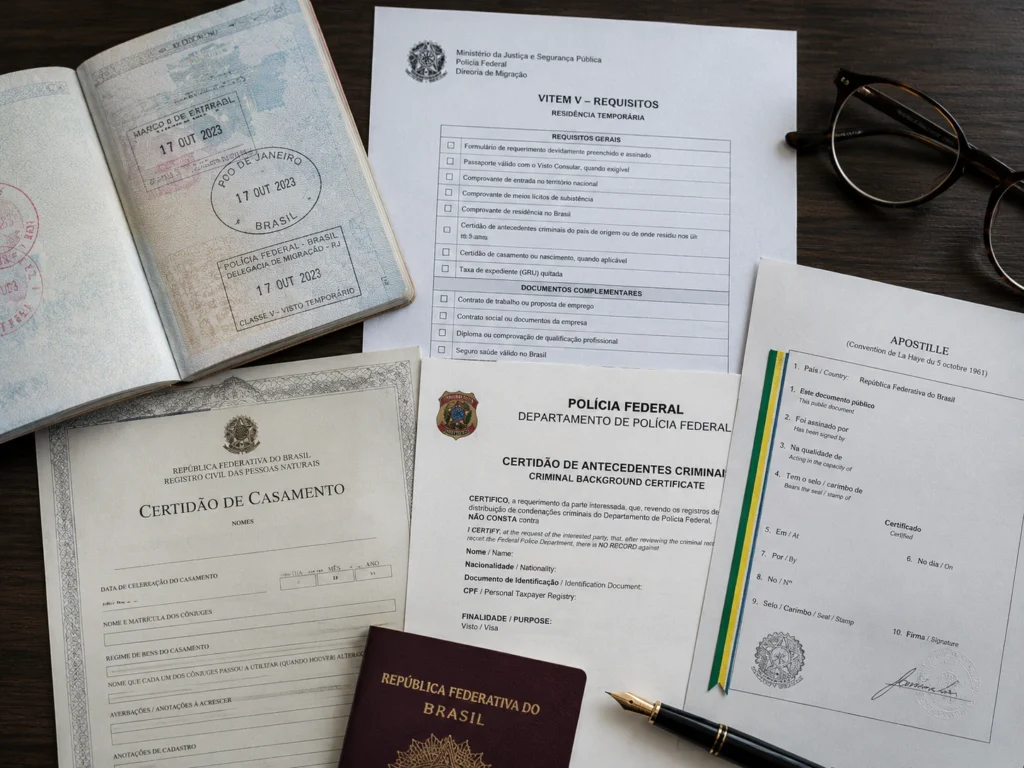
The required documentation varies depending on the type of employment relationship, but there is a core set of documents required for most applications:
- Travel document or official identification document from abroad.
- Birth certificate, marriage certificate, or equivalent document that proves the family relationship.
- Criminal background checks from the countries where you have resided in the past five years, or a statement in the absence of such documents.
- Proof of payment of fees and the issuance of the immigration document, where applicable.
- Application Form filled out according to the category.
Documents issued abroad usually require an apostille and a certified translation. This is an issue that causes delays when handled at the last minute.
How long does the family meeting last, and what are the deadlines?
Residence for family reunification is contingent on the sponsor’s status. When the relationship is with a temporary resident, the validity of the sponsorship coincides with that of the sponsor.
Once approved, there is one mandatory step remaining: registration with the Federal Police and the issuance of the National Migration Registration Card (CRNM). According to the guidelines of the Federal Police on immigration records, Those entering on a temporary visa have 90 days after arrival to register. Those whose residence permits have been approved while in Brazil have 30 days from the date of publication in the Official Gazette.
Missing these deadlines results in a fine and may jeopardize your immigration status. That is why keeping track of dates is part of the process from day one.
Frequently Asked Questions About Family Reunions
What is family reunification in the context of immigration?
This is the legal basis that allows a foreign national to reside in Brazil on the basis of a family relationship. The relationship may be with a Brazilian citizen or with an immigrant who already holds a residence permit. Family reunification is based on the principle that families should remain together in the same country, as guaranteed by the Migration Law.
Who can be invited to a family gathering?
Eligible applicants include the spouse or partner, children, ascendants, descendants up to the second degree, and siblings of the Brazilian citizen or resident immigrant. Foreign nationals who have a Brazilian citizen under their guardianship, conservatorship, or custody are also eligible. Each relationship requires specific supporting documentation.
Does a common-law marriage entitle one to family reunification?
Yes. The law treats a domestic partner the same as a spouse, without discrimination. The key point is proving the common-law marriage, which follows its own rules and requires appropriate documentation. Because it involves specific details, common-law marriage for foreigners is usually treated as a separate issue within the context of family reunification.
Does a foreign spouse need a work visa to work with this type of residency?
A residence permit for family reunification allows a foreign spouse to live in Brazil legally. For employment purposes, it is important to verify the terms of the permit granted and whether additional documents, such as a CPF and CTPS, are required. Ensuring compliance with the regulations helps avoid problems with the employment relationship.
What documents do I need to prepare in advance?
The main documents are an ID card, a certificate proving family ties, and a criminal record. Foreign documents usually require an apostille and a certified translation. Organize additional services such as apostille certification and certified translation Early intervention reduces the risk of delays in the protocol.
Is residency for family reunification permanent?
Not always. The duration of stay usually depends on the applicant’s circumstances and may be for a fixed or indefinite period. Once the required period of residence has been completed, the possibility arises of pursuing more stable options, depending on the specific case and the applicable laws.
Conclusion
Family reunification is the legal way to keep a family together when a foreign national moves to Brazil. It applies both to expatriates who bring their spouses and children and to foreign nationals who have a direct family relationship with a Brazilian citizen.
The key lies in the details: correctly classifying the employment relationship, providing the necessary documentation, and meeting the Federal Police’s registration deadlines. These are the factors that distinguish an approved application from one that is rejected due to incomplete documentation.
For those planning their future in the country, obtaining residency through family reunification is also the first step on a longer journey, which may eventually lead to Brazilian naturalization once the requirements are met. Understanding each step from the start is what makes this process predictable.