Visa exemption for Chinese in Brazil: what changes in 2026
Since May 11, 2026, Chinese citizens have been able to enter Brazil without a visa for stays of up to 30 days, for tourism, business, cultural, sporting activities, family visits or transit. The measure is valid until December 31, 2026 and was formalized by a memorandum of understanding published in the Federal Official Gazette.
For multinational companies with a flow of professionals between the two countries, the news opens up an important operational window. Corporate meetings, due diligence, training and short-term technical visits will be more streamlined. But there is a limit that needs to be clear from day one: the exemption does not replace a work visa and does not authorize paid activity in Brazil.
This article explains what the exemption covers, what continues to require temporary visas and residence permits, and how to structure Brazil-China corporate mobility within this new scenario without falling foul of immigration irregularities.
4. DEVELOPMENT
What the visa waiver for Chinese nationals in Brazil covers
The exemption is reciprocal. Brazilians have been able to enter China without a visa since June 2025, and now Brazil applies the same treatment. The agreement is temporary, initially valid until December 31, 2026, and covers trips of 30 days for tourism, business, artistic, cultural, recreational and sporting activities, as well as visits to family members, participation in conferences, congresses or meetings.
In practice, the visa waiver applies to:
- Short-stay tourism
- Business visits (meetings, prospecting, due diligence, closing contracts)
- Corporate events, conferences and congresses
- One-off artistic, cultural or sporting activities
- Family visits
- International transit
The authorized stay is up to 30 days per entry, The memorandum was announced by Vice President Geraldo Alckmin during the Salão de Turismo in Fortaleza. The memorandum was announced by Vice-President Geraldo Alckmin during the Salão do Turismo in Fortaleza, and published in the Federal Official Gazette and valid until December 31, 2026.
What still requires a work visa in Brazil
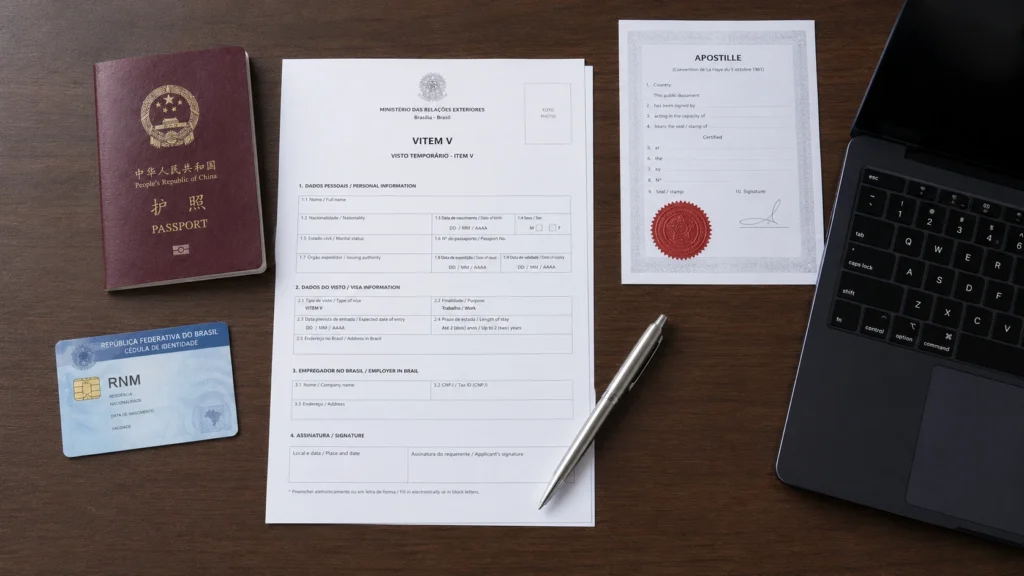
This is the point that generates the most confusion. The exemption authorizes entry, not work. Chinese citizens who intend to engage in paid work in Brazil, act as company managers, provide technical services or settle for a prolonged period of time are still required to obtain the corresponding temporary visa and, before that, a prior residence permit.
According to Immigration Portal of the Ministry of Justice and Public Security, The prior residence permit for work purposes is granted by the General Coordination of Labor Immigration to immigrants who are abroad and is required, with a few exceptions, by the Brazilian consular authorities for the purpose of granting a temporary visa.
The main visa categories that are still applicable to Chinese professionals:
| Visa / Resolution | Purpose |
|---|---|
| VITEM V (RN 02) | Employment in Brazil |
| VITEM V (RN 03) | Non-employment technical assistance |
| VITEM V (RN 04) | Technology transfer |
| VITEM XI (RN 11) | Manager, administrator or representative of a foreign company |
| VITEM XIII (RN 13) | Individual investors |
| VITEM IV | Research, teaching or academic extension |
| VITEM IV | Study (undergraduate, postgraduate, exchange) |
| Residence Permit (RN 23) | Residence in other cases provided for by law |
Even entry as a visitor under the new exemption rule must respect the declared purpose of the trip. Conducting paid activity during the 30-day period is a migratory irregularity, with consequences ranging from a fine to being barred from future entry into the country.
What the exemption changes for companies with Brazil-China mobility
Multinational companies with active operations between Brazil and China are the first to benefit. The flow of people for short missions, technical visits and corporate meetings gains operational agility. Previously, consular appointments in Beijing or Shanghai were a recurring bottleneck in tight deadlines. Now, for trips of up to 30 days, this step disappears.
The practical gains for the Global Mobility area include:
- Rapid response to operational demandsChinese executives can travel to Brazil for board meetings, audits, due diligence or training without awaiting consular issuance.
- More predictable corporate eventsconventions, regional kick-offs and international workshops are easier to organize with Chinese guests.
- Reduced administrative costsless consular fees, less paperwork, less waiting time.
- More predictability for Asian suppliersTechnical visits by Chinese suppliers to factories and construction sites in Brazil no longer depend on the consular calendar.
In processes run by consultancies such as Target Relocation, this operational gain needs to be combined with a clear internal protocol: the company identifies from the initial briefing whether the trip falls within the exemption or whether it requires a formal visa. The decisive criterion is the purpose of the stay, not the duration.
How to differentiate between visa-free and visa-required travel
The key question is simple: is the Chinese professional going to engage in paid activity, provide services, hold a position or reside in Brazil? If the answer is yes to any of these points, the exemption does not apply.
A practical filter in four questions:
- Will the stay be up to 30 days? If you are older, you will need a visa or residence permit.
- Will the professional receive remuneration from a Brazilian source? If so, it requires VITEM V and prior authorization.
- Will the professional work as a manager, administrator or company representative in Brazil? If so, it requires VITEM XI (RN 11).
- Will the professional provide technical services, technology transfer or regular professional training? If so, it requires the corresponding RN from the CNIg.
Activities that clearly fall under the exemption: attending a corporate meeting, visiting a supplier, attending a trade fair, closing a contract on a business trip, carrying out one-off due diligence, attending a conference, short training without remuneration in Brazil.
Activities that don't fit in: working in Brazil (even remotely for a Chinese company, in some cases), taking on an executive position in a Brazilian subsidiary, providing ongoing technical services, moving with the family for an extended period of time.
In the case of short-term technical services, the technical visa RN 03 remains the appropriate formal route, even when the total duration of the mission is less than 30 days, if there is a link with a Brazilian contracting client.

And for Chinese who want to settle in Brazil
The exemption is an instrument for short-term mobility, not establishment. Chinese professionals who intend to live in Brazil for more than 30 days, work in an employment relationship, open a business, invest or bring their family need a formal migration framework.
The standard flow for a Chinese expatriate taking up a position in Brazil:
- Prior residence permitThe calling company in Brazil files the application with the Ministry of Justice and Public Security, via the MigranteWeb system, with the applicant's documentation and the applicable NR.
- Analysis by the CNIgThe process is evaluated by the General Coordination of Labor Immigration. If approved, the permit is published in the Official Gazette.
- Issuing a consular visaWith the authorization in hand, the professional applies for a visa at the competent Brazilian consular office in China.
- Entry into BrazilWith the visa stamped, the expatriate enters the country.
- Registration with the Federal PoliceWithin 90 days of landing, the professional registers biometrically and obtains the National Migration Registration Card (CRNM).
- Additional documentationCPF, bank account opening, driver's license for foreigners, rental contract, children's school enrollment when applicable.
This flow is the same as that applied to any expatriate of foreign nationality subject to regular migration control. The difference introduced by the exemption is only on the short trip front, without changing anything for settlement.
For cases in which the professional has been in Brazil for years and considers the Brazilian naturalization, The rules remain unchanged: minimum residence, knowledge of Portuguese, civil conduct and other criteria of the Migration Law.
Practical risks and how to mitigate them
The window opened by the exemption brings opportunities, but also increases the risk of misuse. Companies that treat all travel as “exempt business” can expose themselves to immigration sanctions when, in practice, the activity constitutes work.
The critical points to note:
- Confusion between meetings and regular workAttending one-off meetings is business. Taking on a role in a Brazilian subsidiary is work.
- Overlap with local payThe following applies: receiving payment from a Brazilian source during a 30-day stay characterizes paid activity.
- Excessive repetition of entriessuccessive entries with short deadlines could be interpreted by the Federal Police as an attempt to circumvent the regular migration regime.
- Lack of supporting documentationEven when exempt from the visa requirement, travelers must carry proof of the purpose of the trip (invitation letter, corporate agenda, hotel reservation, return ticket).
- Change of object after arrivalIt is irregular to start a trip as a visitor and, in the middle of it, take on an executive position.
Mitigation involves an internal mobility protocol that correctly classifies each trip right from the briefing. Target Relocation, with more than two decades of experience in corporate immigration for multinationals, conducts this framework on a case-by-case basis, identifying when the trip is in fact exempt and when it requires a formal visa protocol. The cost of getting this classification wrong is disproportionately higher than the cost of validating it first.
FAQ
Frequently asked questions about the visa waiver for Chinese nationals in Brazil
What is the visa waiver for Chinese nationals in Brazil in 2026?
Chinese citizens with ordinary passports who travel to Brazil for stays of up to 30 days for tourism, business, cultural, sporting, family visits or transit purposes are exempt from consular visas. The measure is reciprocal and valid until December 31, 2026, as reported by CNN Brasil.
Does the exemption allow a Chinese person to work in Brazil?
No. The exemption authorizes entry and stay as a visitor, without any paid activity from a Brazilian source. To work in Brazil, Chinese professionals need a temporary visa (VITEM V in cases of employment) and a prior residence permit issued by the Ministry of Justice and Public Security.
How long can a Chinese person stay in Brazil without a visa?
Up to 30 days per entry. The exemption does not authorize prolonged stay or establishment of residence. Stays of more than 30 days require a temporary visa, residence permit or another situation under the Migration Law (Law 13.445/2017).
Does the exemption apply to technical visits by Chinese suppliers?
This applies to one-off visits of up to 30 days with a compatible purpose: attending a meeting, inspecting an installation, attending training, closing a contract. When the activity constitutes the provision of a technical service with a contract and consideration, the formal route is still the following technical visa provided for in NR 03.
How should a multinational company adapt its mobility protocol?
The recommendation is to include a classification criterion in the initial briefing for each trip between Brazil and China. If the stay is up to 30 days and the purpose is clearly a visit, the company operates under the exemption. If there is local remuneration, an executive position in the subsidiary or the provision of technical services, the company triggers the formal visa protocol. Consultancies specializing in global mobility, such as Target Relocation, structure this classification flow to reduce the risk of irregularities.
Can the exemption be extended after December 31, 2026?
The published memorandum provides for initial validity until that date. Extensions or conversion to a permanent regime depend on bilateral negotiations between Brazil and China and the publication of a new act. Until a new official publication, the recommendation for companies is to plan corporate trips taking into account the current validity horizon.
What do Chinese professionals need to bring even if they are exempt from the visa requirement?
Valid ordinary Chinese passport, supporting documentation for the purpose of the trip (invitation letter from the Brazilian company, corporate agenda, proof of accommodation, return ticket) and, if requested by the Federal Police on landing, proof of means of subsistence during the stay. The exemption eliminates the visa, not immigration control on entry.
CONCLUSION
The reciprocal visa exemption between Brazil and China ushers in a moment of greater fluidity for short-term corporate mobility between the two countries. For companies with a regular flow of professionals, technical missions, events and executive meetings, the operational gain is real and measurable.
The point that distinguishes an organized operation from one exposed to risk is the classification criterion. Every trip needs to be read at source: is it a visit covered by the exemption or an activity that requires formal classification under one of the Normative Resolutions of the National Immigration Council? The answer to this question defines the path.
The window is open until the end of 2026, but the regular regime of work visas, residence permits and additional documentation for foreigners continues to apply in parallel. Mature corporate mobility is exactly that: taking advantage of the agility of the exemption where it fits and maintaining formal protocol where it is required. The difference between the two scenarios is not the length of the trip, but the nature of the activity that will be carried out in Brazilian territory.