Difference between B1 and B2 visas: which one is right for your trip to the USA
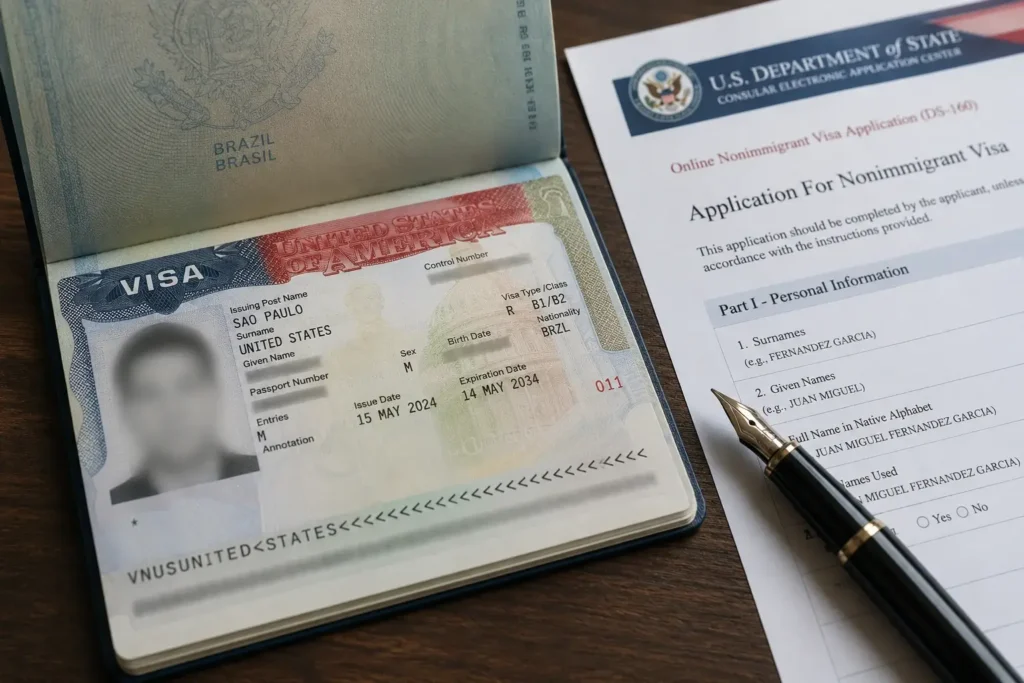
The difference between B1 and B2 visas lies in the purpose of the trip to the United States. The B1 is for unpaid business, such as meetings, conferences and negotiations. The B2 is for tourism, personal visits or medical treatment. The consulate almost always issues both visas on the same stamp: the B1/B2.
For Brazilian executives and corporate teams who travel to the US frequently, this difference is not a technicality. It's what defines whether entry into the country will go smoothly or turn into a lengthy conversation at immigration. Declaring the wrong activity to the officer can result in detention, missing the connecting flight or, in extreme cases, refusal of entry with a direct impact on the operation.
In this article, you will understand what each category allows, when the combined B1/B2 is sufficient, when it is not, and how to prepare a trip that respects the correct use of the visa.
What is the B1 visa and what is it for?

The B1 visa is a temporary entry permit to the USA for business activities that do not involve employment with an American company. It caters for those traveling for a specific professional purpose, without characterizing employment on US soil.
Activities permitted by B1 include:
- Meetings with clients, suppliers or business partners
- Participation in scientific, professional or educational conferences, fairs, seminars and conventions
- Negotiating contracts
- Occasional technical consultations with local subsidiary or partner
- Short unpaid trainings from an American source
- Independent research
- Litigation
The key point: the B1 does not authorize paid work, service with payment by a company in the USA or formal employment. The difference is subtle but decisive. An executive from a Brazilian parent company can take part in a strategy meeting at the American subsidiary. The same executive cannot, under B1, perform operational tasks that replace a local worker.
The rule is detailed by the US State Department in the official fact sheet on the B-1 visa and permitted uses, which serves as the basis for consular and border officials' (CBP) decisions.
Who needs the B2 visa and what does it allow?
The B2 visa is the visitor category for recreational and personal purposes. It covers what most Brazilians understand as a “tourist visa”.
Activities supported by B2 include:
- Tourism and leisure
- Visiting family or friends living in the USA
- Medical treatment in an American institution
- Short courses of a recreational nature, without academic credits (a two-day cooking class during the vacations, for example)
- Participation in social events and amateur fraternities without pay
The B2 does not authorize formal study (which requires an F-1 or M-1 visa), paid work or professional activity that overlaps with the business category. Anyone who enters with a B2 and tries to justify a business meeting to immigration runs the real risk of being questioned.
Why does the consulate usually issue the combined B1/B2?
In practice, the American consulate in Brazil mostly issues the B1/B2 visa combined in a single document. Current reciprocity between Brazil and the United States provides for a validity of up to 10 years for this visa, and each entry allows for a stay of up to six months, defined by the immigration officer on arrival.
The consulate's logic is simple: most applicants will, at some point in the next decade, make both business and leisure trips. Issuing a single category avoids reopening the process with each new trip.
There are exceptions. In specific situations, the consulate only issues the B1, as in the case of domestic workers or nannies accompanying an eligible employer on a temporary trip to the USA. For most Brazilian executives, however, the combined B1/B2 is the standard category.
What's the difference in practice when you arrive at immigration?
Having B1/B2 stamped in your passport does not mean automatic entry into the USA. The CBP (Customs and Border Protection) officer makes a second assessment at the border, at which point the stated purpose of the trip needs to be aligned with the visa category and the documents you are carrying.
The rule of thumb:
| Situation | What to tell the officer | Documents to have at hand |
|---|---|---|
| Meeting with an American client | Business (B1) | Company invitation letter, travel agenda |
| Sector conference in Las Vegas | Business (B1) | Event registration, proof of payment |
| Visiting family in Orlando | Tourism (B2) | Host's address, proof of return to Brazil |
| Business + leisure days afterwards | Business (B1), with a clear leisure plan | Invitation letter + hotel/tour booking |
| Medical treatment in Houston | Treatment (B2) | Hospital letter, financial treatment plan |
The most common mistake is the executive who enters as a tourist to “avoid bureaucracy” and then exchanges cards with clients or shows up at scheduled meetings. If CBP finds out, and they often do, the history is recorded and can jeopardize future entries.
A US Embassy in Brazil provides guidance on each category of non-immigrant visa and reinforces that consistency between what is on the DS-160, what is said at the consular interview and what is declared to CBP is a continuous eligibility criterion.
When B1/B2 isn't enough and you need another visa
B1/B2 covers most short corporate and leisure trips by Brazilians to the USA. There are, however, situations in which it is insufficient, and trying to force its use is often costly.
You need a different visa when:
- He'll be working for an American company. The correct category is the H1B visa (specialized professional) or similar.
- You will be transferred by your company's headquarters to a subsidiary in the USA. The appropriate visa is the L1 (intracompany transfer).
- You're going to study a course with academic credits, an exchange or a degree. The correct visa is the F-1 or M-1.
- It will invest capital and operate a company in the USA. Categories E-2 (investor) or EB-5 (residency by investment) are indicated.
- You will obtain permanent residence based on employment. The EB-2 and EB-3 categories cover this scenario. It's worth following recent rule changes, such as the new status adjustment protocol for the EB-2 visa, This has a direct impact on corporate mobility planning.
For companies that receive international talent in Brazil or send Brazilian professionals to the US for work purposes, the way forward is through dedicated migration planning, not B1/B2 adaptation.
How to prepare for the consular interview and avoid refusal
The consular interview lasts an average of a few minutes. During this time, the officer assesses three things: the consistency of your profile, the consistency of the information on the DS-160 and the clarity of the purpose of the trip.
Good practices for the B1/B2 interview:
- Fill in the DS-160 form with attention to every detail. Inconsistencies between the form and the interview are one of the main causes of refusal.
- Be clear about the main purpose of the trip. If it's business, say business. If it's tourism, say tourism. Don't try to “embellish” the answer.
- Bring documents to support your story. Company invitation letter, event agenda, proof of conference registration, hotel reservations.
- Demonstrate solid links with Brazil. Stable job, property, family, tax return. The officer needs to see that you have reasons to return.
- Know the proposed length of stay. Have an approximate return date and be able to explain it.
For companies that send executives frequently, standardizing the invitation letter, organizing the travel schedule and training the professional before the interview drastically reduce the risk of rejection. This is the kind of preparation that visa and residence advice from Target Relocation performs for more than 70 multinationals from São Paulo, with national coverage.
What happens if you use the wrong category?
Using the wrong visa category, or entering with a B2 and carrying out a B1 activity, has consequences that vary according to the severity:
- Prolonged questioning at the CBP. The officer can detain the passenger in a secondary inspection room for hours.
- Note in the history. Entry can be authorized, but with a flag in the system that will weigh on future trips.
- Refusal of entry and immediate return to Brazil. The traveler is boarded on the next flight, with the cost of the ticket usually borne by the traveler.
- Cancellation of visa. The officer has the authority to annul the visa on the spot, requiring a new consular application for future trips.
- Future ineligibility. Repeated cases or bad faith can lead to permanent inadmissibility, requiring a waiver for any future entry.
The cost of an ill-informed decision can be disproportionate to the “shortcut” it tries to offer. For companies, it means a critical executive out of an operation at the wrong time. For the corporate mobility team, it means a reputational and logistical problem.
If the scenario involves bringing foreign professionals to operate in Brazil, it's also worth knowing the main paths to a work visa for foreigners in Brazil, These are similar in logic: use the right category for the right activity.

FAQ
What is the difference between B1 and B2 visas?
The B1 visa authorizes unpaid business activities in the USA, such as meetings, conferences and negotiations. The B2 visa covers tourism, personal visits and medical treatment. In practice, the American consulate usually issues the two combined visas in the same document, the B1/B2, which is valid for up to 10 years for Brazilians.
How do I know if I need B1, B2 or B1/B2 combined?
Assess the real purpose of the trip. If it's business without remuneration from an American source, it's B1. If it's tourism, leisure, a visit or medical treatment, it's B2. If you often travel for both reasons over the years, the combined B1/B2 is the option that the consulate usually issues and covers both purposes.
Can I work in the USA with a B1 or B2 visa?
No. Neither B1 nor B2 authorizes paid work in the United States. The B1 allows occasional professional activity with no employment relationship with an American company. For work with a salary paid by a company in the US, the appropriate categories are H1B, L1, O1 or other employment-specific visas.
What is the maximum length of stay with a B1/B2 visa?
The length of stay per entry is set by the immigration officer on arrival and is usually up to six months. The validity of the visa, in turn, is up to 10 years for Brazilians, in accordance with reciprocity between Brazil and the USA. Exceeding the authorized time is a serious infraction, with the risk of visa cancellation and future ineligibility.
Is it worth hiring specialized advice for the B1/B2 visa in São Paulo?
For individual travelers with a simple profile, the process can be handled alone. For executives with frequent trips, companies with structured mobility programs and cases of renewal after previous refusal, consultancy reduces the risk of errors in the DS-160, organizes supporting documentation and prepares the applicant for the consular interview. In São Paulo, where most of the high-demand consulates are located, this work is usually carried out in a shorter period of time.
How does the immigration officer decide if I can enter the USA even with a valid visa?
The CBP officer assesses on arrival whether the stated purpose of the trip is compatible with the visa category and the documents presented. An invitation letter, schedule of events, hotel reservations and proof of return to Brazil weigh in favor. Inconsistencies between what is on the DS-160, what was said at the consular interview and what is declared to CBP weigh against the application.
CONCLUSION
Understanding the difference between B1 and B2 visas is less a question of bureaucracy and more a question of coherence between intention, document and practice. B1 is the category for business activities without an American employment relationship. B2 covers tourism, visits and medical treatment. The combined B1/B2, which is the standard issued to Brazilians, covers both purposes throughout the decade of the visa's validity.
The greatest risk lies not in the choice of category, but in the mismatch between what is declared and what is executed on American soil. In a scenario where the American consulate is dealing with a growing volume of Brazilian requests and the CBP is acting in an increasingly protocolary manner, aligning actual activity, consular declaration and supporting documentation is no longer a detail but a prerequisite.
For professionals who travel frequently to the US and for corporate HR coordinating teams on international mobility, it's straightforward: the right category, prepared in advance and supported by coherent documentation, is what separates a productive trip from a secondary inspection room in Miami.