Immigration in Brazil: from Cultural Legacy to Corporate HR
Immigration in Brazil is both a cultural legacy of more than 150 years and an active corporate movement. In 2025, the country granted more than 60,000 work visas to foreign professionals, an increase of 28% over 2024. The same country that welcomed Italians, Japanese, Germans and Arabs now welcomes engineers, executives and technicians on transfer.
This context has changed what is expected of those who manage mobility. Today, immigration isn't just about consular bureaucracy. It's about travel plans, family documentation, school hunting, housing, a valid work contract, and tax closure in the country of origin. Global HR and mobility need to orchestrate all this without exposing the company to migratory liabilities. And without the professional starting the mission exhausted.
This article connects the two ends. It shows what history has left as a cultural backdrop. What current regulations require in practice. And how to structure an international transfer with predictability.
How did the history of immigration in Brazil reach today's corporate HR?
Brazil's migratory cycles came in different waves, each one redesigning entire sectors of the economy. The basis is cultural. The practical reflection shows up in where multinationals are today and in what profile of talent they continue to attract.
- Italians in the South and São Paulo: opened up the agro-industrial chain, wine, coffee and the industrial base of São Paulo.
- Japanese in São Paulo and Paraná: introduced commercial horticulture and formed one of the largest Asian hubs outside Asia.
- Germans in Santa Catarina and Rio Grande do Sul: consolidated engineering, metalworking and the industrial cluster of the Itajaí Valley.
- Arabs and Lebanese in São Paulo and the North: structured wholesale trade and high street retail.
- Koreans, Chinese and Bolivians in Brás and the East Zone of São Paulo: shaped fast fashion and clothing.
This cultural diversity is the backdrop that welcomes the modern expatriate. When a Chinese engineer arrives in Suzano for an industrial plant, or an Indian executive moves to Av. Paulista, the host country is already multicultural by construction. This reduces the initial cultural friction, but does not eliminate bureaucratic friction, which is the critical point for the hiring company.
Why is immigration in Brazil on the rise again and what does this mean for the company?
Labor immigration in Brazil has accelerated again. According to International Migration Observatory (OBMigra), of the Ministry of Justice, In 2019, the country granted more than 60,000 work visas in 2025. Growth was 28% over 2024 and more than 80% over 2019. The driving force is foreign investment in oil and gas, renewable energy, technology, the automotive industry and mining.
The main countries of origin have changed. China, the Philippines, the United States, the United Kingdom and India lead the ranking of authorized workers. The profile is mostly qualified: engineers, maintenance technicians, transfer executives, technology transfer specialists.
For the company, this scenario has three implications:
- Volume and deadlineThe MigranteWeb system and the consulates are now handling larger volumes. Faulty documentation delays the arrival of professionals.
- Migration complianceVisa errors can lead to fines, deportation and, in extreme cases, temporary restrictions on new foreign hires.
- Total assignment cost: a visa is just the door. Housing, school, transportation, taxes and cultural adaptation weigh more heavily on the budget than the documentation itself.
This is the point at which international mobility stops being operational HR and becomes a strategic function. It's worth delving into the main paths to international contracting in Brazil when the topic is the right visa for each profile.
What are the main visas for immigration to Brazil today?
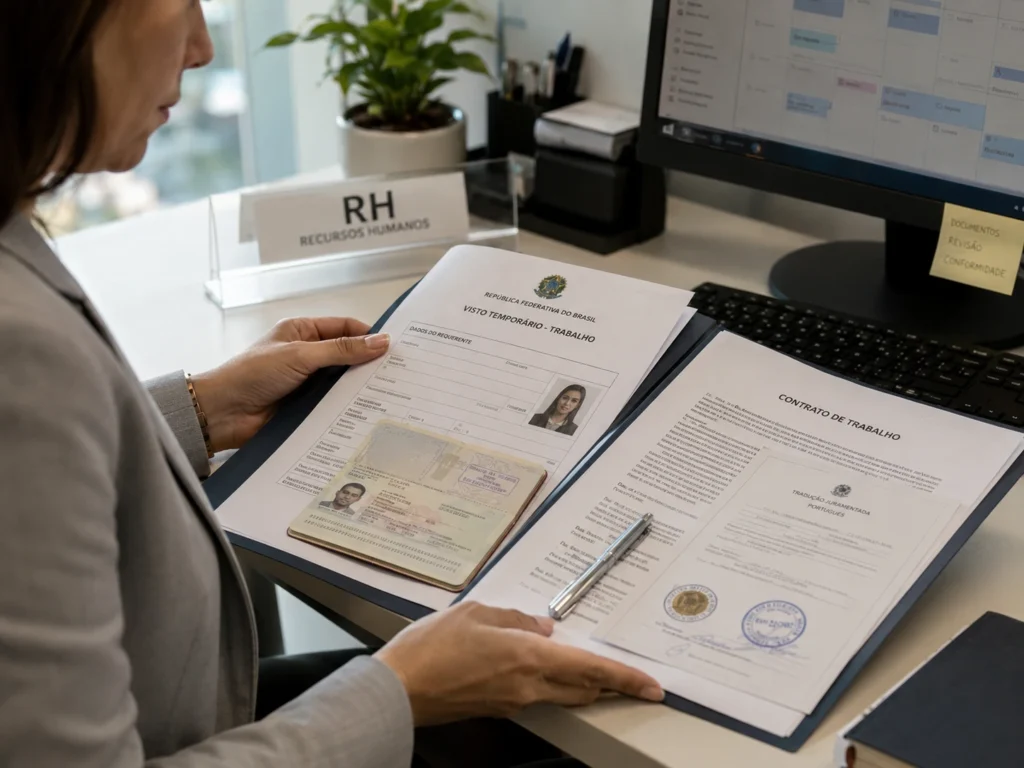
The Migration Law (Law 13.445/2017) and Decree 9.199/2017 organize the legal entry of foreigners. For corporate use, the most commonly used routes are:
| Modality | When it applies | Start of the process |
|---|---|---|
| VITEM V (Temporary Work Visa) | Professional hired by a Brazilian company or transferred internally from a multinational company | Company opens Residence Permit in MigranteWeb system |
| VITEM XI (Investor) | Foreigner with minimum contribution defined by CNIg | Request via the Federal Police after entry |
| Visit visa for short technical assistance | Foreign technician in technology transfer or equipment maintenance for up to 180 days/year, with no ties in Brazil | Consulate, according to Decree 12.657/2025 |
| Residence permit for family reunion | Spouse and children of the hired professional | Federal Police after arrival |
The correct decision between these modalities is not trivial. VITEM V requires a prior residence permit issued by the Ministry of Justice. The technical assistance modality of up to 180 days became a relevant alternative after Decree 12.657/2025. But it has strict conditions: the technician cannot be employed in Brazil or receive a salary from a national source.
What changes in the expatriate's cultural and family adaptation?
The paperwork comes at the end of the process. The life of the professional and the family begins afterwards. This is the point at which poorly structured relocation projects fail. The company guarantees the visa, but the expatriate asks for an early return in 6 months due to failure to adapt to the family.
The critical adaptation blocks are:
- Home finding: mapping by region, children's school, security, access to the office. São Paulo concentrates most of the corporate volume. Rio, Curitiba, Campinas and oil and gas cities like Macaé are also included.
- School hunting: international schools, bilingual schools, school calendar, enrollment process.
- Day-to-day documents: CPF, CNH, bank account, health insurance, consular certificate, sworn translation.
- Intercultural integration: guidance on work culture, hierarchy, communication and the use of Portuguese in everyday life.
- Taxation in Brazil and in the country of origin: tax residence, exit declaration, double taxation. Brazilian IRPF is levied from the 184th day.
- Pets: health documentation, transportation and quarantine where applicable.
When the expat arrives with the family organized and HR has a relocation partner to take care of these blocks, the assignment meets the business objective. When it doesn't, it becomes a cost of rework.
Before signing up to the executive's package, it's worth understanding how to avoid unnecessary expenses in an international move.
How should HR plan immigration in Brazil without becoming a bottleneck?
Corporate HR becomes a bottleneck when it treats each case as an isolated project. Good practice is to build a mobility playbook that covers the entire cycle, from offer letter to repatriation. The minimum steps are:

- Case diagnosis: type of contract, term, position, family profile, country of origin, urgency.
- Defining the right visa: based on the profile. Errors at this stage create consular rework.
- Documentation in the country of origin: certificates, diploma, background certificate, sworn translation.
- Residence permit via MigranteWeb: opening on the Brazilian side.
- Getting a visa at the consulate: The deadline varies per consulate.
- Arrival and registration with the Federal Police: RNM (Registro Nacional Migratório) and CPF for each family member.
- Look & see or home finding: home and school before moving permanently.
- International transportation: moving personal and pet property.
- Fiscal onboarding: account opening, definition of tax residence, tax briefing.
- Cultural integration: guidance for expatriates and their spouses.
- Renewal and repatriation: monitoring the visa period and exit plan.
Target Relocation acts as an extension of the HR team at all these stages. It has national and international coverage from São Paulo. Instead of HR working on 11 fronts with 11 suppliers, it operates with a single point of contact for the entire operation.
FAQ
Frequently asked questions about immigration to Brazil
What is immigration in Brazil today in practice?
This is the legal and operational process a foreigner goes through to live and work in Brazil. It involves the correct visa for the profile, Residence Permit via MigranteWeb, registration with the Federal Police, CPF, CNH when applicable and family adaptation. In corporate use, it is the complete international transfer cycle, from hiring to repatriation.
How does a company in São Paulo hire a foreign professional?
The hiring company applies for a prior residence permit through the MigranteWeb system, linked to the Ministry of Justice. Once granted, the professional applies for a work visa (VITEM V) at the Brazilian consulate in their country of origin. When they arrive, they register with the Federal Police and obtain their RNM. Each stage requires specific documentation in Portuguese, translated and legalized.
How long does the entire expatriate immigration process take?
It varies depending on the consulate, the country of origin and the volume of demand. On average, the Residence Permit takes between 30 and 60 days. Issuing the visa at the consulate takes another 15 to 45 days. Registration with the Federal Police takes up to 90 days after arrival. Errors in documentation or translation can double this time. To better understand the current trend, it is worth following the Historical high in the granting of work visas in Brazil.
What are the main mistakes that slow down an immigration process in Brazil?
The most common are five. Choosing the wrong type of visa. Sending a document without a sworn translation. Not complying with the technical qualification requirement set out in the CNIg's Normative Resolution. Missing the deadline for registering with the Federal Police. Failing to plan for the expiration date of the Residence Permit. Each of these delays arrival and generates extra costs for the company.
Does immigration to Brazil affect the taxation of the company and the expatriate?
Yes. From the 184th day of their stay in Brazil, professionals become tax residents. This changes the way their salary, benefits and any assets in their country of origin are taxed. The company needs to structure a tax equalization policy. The professional must formalize the tax exit from the country of origin to avoid double taxation.
What is the difference between a visa, a residence permit and an NMR?
A visa is permission to enter Brazil, issued by the consulate. The Residence Permit is the permission to stay and work, issued by the Ministry of Justice. The RNM is the resident foreigner's physical identification document, issued by the Federal Police. The three are complementary and each has its own rules for validity and renewal.
CONCLUSION
Immigration in Brazil today is two overlapping phenomena. The cultural legacy of more than 150 years, which makes the country receptive by construction. And contemporary corporate operations, which demand planning, compliance and speed. The two worlds meet at the moment when HR needs to transform a business decision into a concrete arrival of a person and family.
Brazil has once again become a major destination for international talent. The OBMigra figures confirm this growth and show a clear pattern. Companies that treat mobility as a strategic function deliver more results. And they lose fewer professionals due to failure to adapt. The same country that has welcomed generations in waves of migration continues to do so. The difference is that now the gateway goes through MigranteWeb, the consulate, the Federal Police and fine coordination between HR, legal and mobility.
The transfer operator needs to see the whole cycle. From hiring to repatriation, with the expatriate and their family at the center.
To understand the path of those who decide to stay in the country for good, it is worth reviewing when a foreigner can become a brazilian citizen through naturalization.