
Schools for Foreigners in Brazil: A School Hunting Guide for Expat Families
Choosing schools for expats in Brazil involves evaluating the international curriculum, language of instruction, educational continuity, and location relative to where you live. International schools adopt curricula such as the International Baccalaureate (IB) and the Cambridge curriculum, which ensure continuity when a family moves to another country. This search process is known as “school hunting.”.
For foreign executives relocating to Brazil with their families, choosing a school for their children is often the most sensitive decision of the entire move. While housing and paperwork are technical matters, education involves the children’s emotional adjustment and the continuity of their studies across countries. The wrong choice leads to extra educational work and family stress.
This guide explains how to approach the school search process: the types of international curricula available, selection criteria, a step-by-step guide to enrollment, the Brazilian school calendar, and the differences between international and bilingual schools. The goal is to provide families with a roadmap for making an informed decision, without having to wing it.
Why is choosing a school so important when moving to Brazil?
School is the cornerstone of a family’s adjustment to an international relocation. While the parent already has a job lined up, the children need an environment that allows them to continue their studies and helps them adapt to the change in language and culture. Making the right choice reduces the stress of the move for the entire family.
Educational continuity is the most sensitive issue. A child who was studying in a British or American system needs to maintain curricular consistency upon arriving in Brazil. Recognized international curricula exist precisely to facilitate this transition between countries without any loss of content.
It’s worth remembering that the school also shapes the daily routine of the entire family at their destination. Start times, vacation schedules, and location all influence commutes, work hours, and social life. That’s why choosing a school isn’t just an educational decision—it’s the key factor that structures the daily life of expats in Brazil.
What happens if a family chooses the wrong school?
A school that is poorly aligned with a child’s profile has practical consequences. Curricular mismatches force students to make up missed content or repeat grades. Language barriers without adequate support slow down learning. Excessive distance between home and school disrupts the daily routine. And, in extreme cases, the child may need to switch schools in the middle of the school year.
That’s why a well-planned school search comes even before deciding on a place to live. The logic is to choose the school first and, based on that, decide on the neighborhood. Reversing this order usually results in long and exhausting commutes on a daily basis.
When should I start looking for a school?
Ideally, you should start looking for a school a few months before the move. Top international schools have limited openings and admissions processes, especially in higher grade levels. Starting early ensures access to the best options and gives you time for in-person visits.
In relocation services, the search for a school begins right at the start of the planning process. Consulting firms such as Target Relocation, which serves more than 70 multinational companies, treat the school search as a separate initiative, coordinated with housing and the family’s arrival.
What are the different types of school curricula for international students?
International schools in Brazil follow different curricula, each with its own characteristics and recognition. Understanding these options is essential for choosing a school that aligns with the child’s educational path and the family’s future destination, should they move again.
Leading international universities in Brazil:
| Resume | Origin | Key Feature |
|---|---|---|
| International Baccalaureate (IB) | International | Globally recognized, with a focus on critical thinking |
| Cambridge | United Kingdom | British curriculum with IGCSE and A-Level certifications |
| American | United States | High school diploma, a prerequisite for U.S. universities |
| National Bilingual | Brazil | Brazilian curriculum with intensive English instruction |
What is the International Baccalaureate (IB) curriculum?
The International Baccalaureate is one of the most widely recognized international curricula in the world. It offers programs for different age groups, from early childhood education through high school, with a focus on critical thinking, research, and global education. The IB diploma is accepted by universities in dozens of countries.
Schools offering the IB program allow students to continue their studies at any other IB school in the world. This is ideal for families who move internationally on a regular basis. You can check which schools are certified through the Official IB School Finder of the International Baccalaureate Organization.
What is the Cambridge curriculum?
The Cambridge curriculum follows the British educational model, with internationally recognized certifications such as the IGCSE and A-Levels. It is the natural choice for families from the United Kingdom or those planning to send their children to British universities. Many schools in Brazil combine the Cambridge curriculum with the IB diploma.
British schools in Brazil typically combine the British national curriculum with these certifications. This offers flexibility: the child gains a solid British foundation and, at the same time, a diploma that is widely recognized internationally.
What is the difference between an international school and a bilingual school?
Many families confuse the two models, but they serve different purposes. This distinction directly affects educational continuity and the acceptance of the diploma abroad. Choosing based on this difference helps avoid future frustration.
An international school follows a comprehensive foreign curriculum, with instruction primarily in another language and a diploma recognized outside Brazil. A bilingual school follows the Brazilian curriculum based on the National Common Core Curriculum, but conducts part of its classes in a second language, usually English.
What characterizes a bilingual school in Brazil?
The bilingual school follows the national curriculum and emphasizes second-language instruction. The national guidelines for multilingual education were established by the National Education Council, based on the Ministry of Education's National Common Core Curriculum. The degree is Brazilian, with a strong emphasis on language.
This model is suitable for families who plan to stay in Brazil for the long term and want their children to earn a Brazilian high school diploma without sacrificing their fluency in English. It is not, however, the best option for those who expect to move abroad again within a few years.
When is an international school the best choice?
An international school is recommended when a family moves frequently or plans for their children to attend universities abroad. The IB, Cambridge, or American curriculum ensures continuity in other countries and a globally recognized diploma. It is the most suitable option for expatriates on international rotations.
For families on a temporary assignment—who plan to return to their home country or move to another location—the international school ensures continuity in the child’s educational journey. The choice therefore depends on how long the family plans to stay in Brazil.
How does school hunting work, step by step?
School hunting is a structured process of searching, comparing, and enrolling. Following this process methodically helps you avoid hasty decisions and ensures that the school you choose truly matches your family’s profile. Here are the steps.
A step-by-step guide to school hunting:
- Define your desired curriculum based on your career path and your future destination country.
- Identify suitable schools in the cities where the family will be living.
- Compare curriculum, language, tuition, availability, and location.
- Schedule and conduct in-person visits to the finalist schools.
- Check for availability in the child's specific grade level.
- Gather the necessary documents and complete the registration.
What criteria should be used to compare the finalist schools?
In addition to the curriculum, it’s worth comparing factors that affect daily life and the adjustment process. Limiting your decision to just the school’s name is often a mistake. Consider:
- Language of instruction and level of support for those who do not yet speak Portuguese.
- Location in relation to the guardian's home and workplace.
- Availability of a spot in the child's exact grade level, not just at the school.
- Academic calendar and start date for the current school year.
- Profile of the school community and experience with international students.
What documents are required for enrollment?
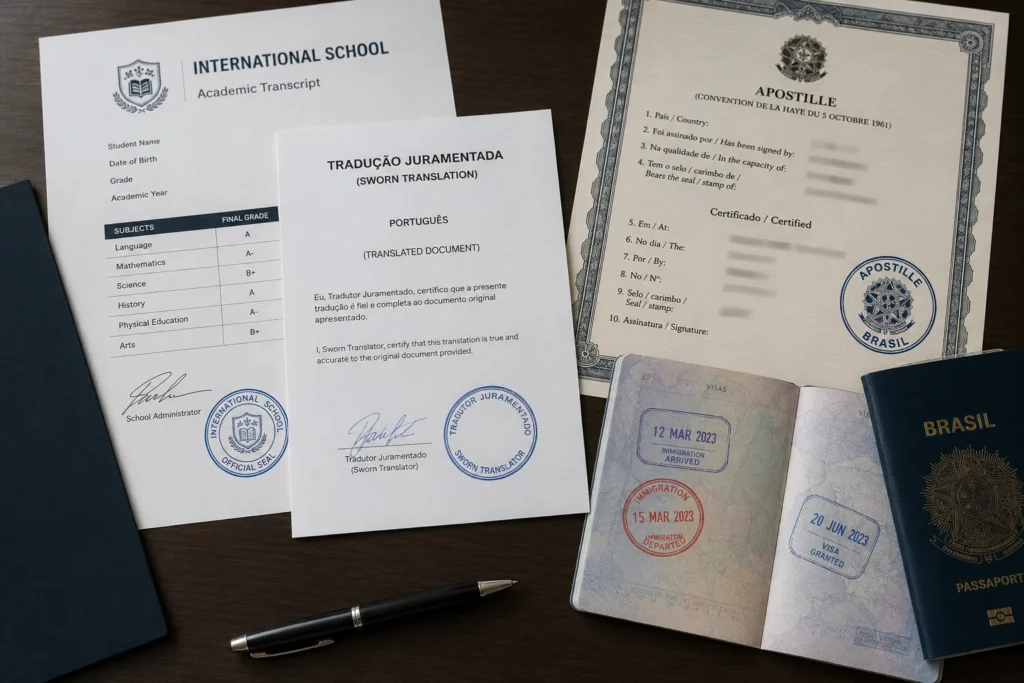
Enrollment in an international school typically requires a transcript from the student’s home country—often with a certified translation and an Apostille—as well as identification documents for the child and their guardians. Foreign documents must be properly authenticated to be valid in Brazil.
This is a point that ties in with the rest of the relocation process. Getting the family’s documents in order—including apostille certification and translation—is the same process that supports visas and registrations. You can find more information about this step in Target’s content on additional documentation solutions.
How does the Brazilian school calendar work for those arriving from abroad?
The Brazilian school year follows the calendar year, beginning in February and ending in December, with summer break in July. This differs from countries in the Northern Hemisphere, where the school year begins in August or September. This difference in the school calendar is something to keep in mind for those who are moving.
A family arriving in the middle of the Brazilian school year may find that their child is at a different point in the curriculum. International schools tend to be more flexible about admitting students outside the regular school cycle, precisely because they deal with global mobility. Even so, planning your arrival around the school calendar helps prevent your child from falling behind and makes the adjustment easier.
In which cities are there international schools in Brazil?
International schools are concentrated in the major cities that attract expatriates, such as São Paulo, Rio de Janeiro, Curitiba, Belo Horizonte, and Campinas. São Paulo has the largest selection, with dozens of international and bilingual schools, followed by Rio de Janeiro. The choice of city directly influences the available options.
Since options vary by city, the decision regarding housing and schools must be made together. Choosing a school in one area and living on the other side of town creates daily commutes that take a toll on the family’s routine. In processes managed by consulting firms such as Target Relocation, school hunting is coordinated with house hunting precisely to avoid this mismatch.
Frequently Asked Questions About Schools for Foreigners
What is school hunting?
School hunting is the structured process of searching for, comparing, and selecting schools for children when moving abroad. It involves identifying schools that align with the desired curriculum, comparing language offerings, tuition, and location; visiting the top choices; and checking for availability in the child’s grade level. It is a distinct component of relocation services.
What is the difference between an international school and a bilingual school?
An international school adopts a complete foreign curriculum, such as the IB or Cambridge, with instruction in another language and a diploma recognized outside Brazil. A bilingual school follows the Brazilian BNCC curriculum and conducts part of its classes in a second language. International schools emphasize continuity across countries; bilingual schools emphasize the national diploma combined with language proficiency.
Do I need to have my children's school transcripts apostilled?
In most cases, yes. Academic transcripts issued abroad usually require apostille certification under the Hague Convention and a certified translation to be valid in Brazil. Each school sets its own documentation requirements for enrollment. Getting these documents in order ahead of time prevents delays in the child’s admission process.
When should I start looking for a school?
Ideally, you should start looking for a school a few months before the move. Top international schools have limited openings and selective admission processes, especially in higher grade levels. Starting early ensures access to the best options, allows time for in-person visits, and gives you the chance to choose your housing based on the school, rather than the other way around.
How does the Brazilian school calendar affect the family's arrival?
The school year in Brazil runs from February to December, with summer break in July, which differs from the Northern Hemisphere calendar. A family arriving in the middle of the year may find their child at a different point in the curriculum. International schools tend to be more flexible about accepting students outside the regular school year, but planning your arrival based on the calendar helps prevent your child from falling behind.
Is it worth using a relocation service for school hunting?
For families unfamiliar with the local education market, yes. A relocation service identifies suitable schools, schedules visits, and coordinates enrollment along with housing and paperwork. Consulting firms like Target Relocation treat school hunting as a dedicated priority, integrated with the rest of the relocation process, which minimizes the need for last-minute decisions regarding one of the most sensitive aspects of the move.
Conclusion
Choosing schools for foreign nationals in Brazil is the decision that has the greatest impact on a family’s adjustment during an international relocation. Unlike housing and paperwork, this decision involves the children’s educational continuity and emotional well-being, which requires a systematic approach and advance planning.
The first step is to understand the available curricula—IB, Cambridge, American, or bilingual—and align them with the child’s educational path and how long the family plans to stay in Brazil. The difference between an international school and a bilingual school is not a minor detail: it determines the continuity of the child’s education across countries and the acceptance of their diploma abroad.
When approached systematically, the school search ceases to be a source of stress and becomes an organized part of the move. Starting early, comparing options carefully, visiting schools in person, and getting the paperwork in order are the steps that make choosing a school the foundation for a successful adjustment to life in Brazil.