
There is now a limit on rescheduling U.S. visa appointments: the appointment system at U.S. consulates in Brazil allows a maximum of three cancellations or reschedulings per application, across all categories. Once this limit is reached, scheduling is blocked, and the applicant must file a new application and pay the consular fee again.
Updated on · Content reviewed by the corporate immigration team at Target Relocation.
Key Points
- The limit on rescheduling U.S. visa appointments is three cancellations or reschedules per application, across all visa categories.
- Cancellations and reschedules count together: each change uses up one of the three allowed changes.
- Once the limit is reached, scheduling is blocked; not even customer support can reschedule the interview, and the applicant must file a new application and pay the consular fee again (US$185 for a B1/B2 visa).
- For the company, the risk of having to reschedule a U.S. visa appointment lies in the doubled cost, the delay in travel, and exposure in large groups.
- It is not yet clear whether the rule also applies to the Visa Applicant Service Center (CASV).
Also known as: visa interview rescheduling limit, consular appointment cancellation policy, maximum number of interview reschedules.
What has changed with the U.S. visa rescheduling policy?
The change is a limit of three interview cancellations or reschedulings per application. The scheduling system at U.S. consulates in Brazil has begun applying this limit to all visa categories, and the U.S. Consulate General in São Paulo has confirmed the rule. The alert has appeared in the system since late September 2026.
With this limit in place, rescheduling a U.S. visa appointment is no longer a free option for adjusting your travel plans. Each change now counts as one of three attempts, and the interview date must be treated as a firm commitment, not as tentative information.
The rule applies to all company travelers, from executives to technical staff, because it applies to all visa categories.
How are cancellations and reschedules tracked?
The count includes both cancellations and reschedulings, with a single limit of three per case. This means that canceling an interview and rescheduling it counts toward the same limit, and that rescheduling a U.S. visa appointment cannot be repeated indefinitely.
Once the limit is reached, scheduling is blocked. Not even system support can change the appointment. The only option is to file a new application and pay the consular fee again. For the B1/B2 visa, the fee is US$185.
| Item | What is known |
|---|---|
| Responsible agency | U.S. Consulates in Brazil (rule confirmed by the U.S. Consulate General in São Paulo) |
| U.S. Visa Rescheduling Limit | A maximum of three interview cancellations or reschedulings per application |
| Who is affected | Applicants for all visa categories |
| What Matters in the End | Cancellations and reschedulings, combined |
| Effective Date | Alert in the scheduling system since the end of September 2026 |
| When the limit is reached | Appointment blocked; new application and new consular fee |
| B1/B2 Consular Fee | US$ 185 |
| Rate for other categories | Amount updated in the U.S. Department of State's official fee schedule |
| Application to CASV | Still unclear |

What are the risks to the company of rescheduling a U.S. visa appointment?
There are three risks: doubled costs, travel delays, and exposure in large groups. Each one affects HR and the Global Mobility department differently.
Cost doubled
Anyone who uses up all three attempts must pay the consular fee again. For the B1/B2 visa, that’s an additional US$185 per person, in addition to the cost of tickets, lodging, and any meetings that need to be rescheduled.
Travel Delay
A new application resets the scheduling process to the beginning, and the available date depends on the number of openings at the consulate. A project, training session, or trade show with a fixed date may be jeopardized.
Exposure in large groups
The larger the group, the greater the chance that someone will reach the limit. In a hypothetical example involving 20 employees, if 5 of them need to file a new B1/B2 application, the company pays an additional US$ 925 in fees (5 × US$ 185), not including operational costs. Managing the rescheduling of U.S. visa appointments for each employee becomes a management issue.
In mobility programs, rework often arises from interviews scheduled before the trip has been confirmed. To learn how to address legal risks in international mobility, read our article on migration compliance.
How can you avoid reaching the limit on rescheduling U.S. visa appointments?
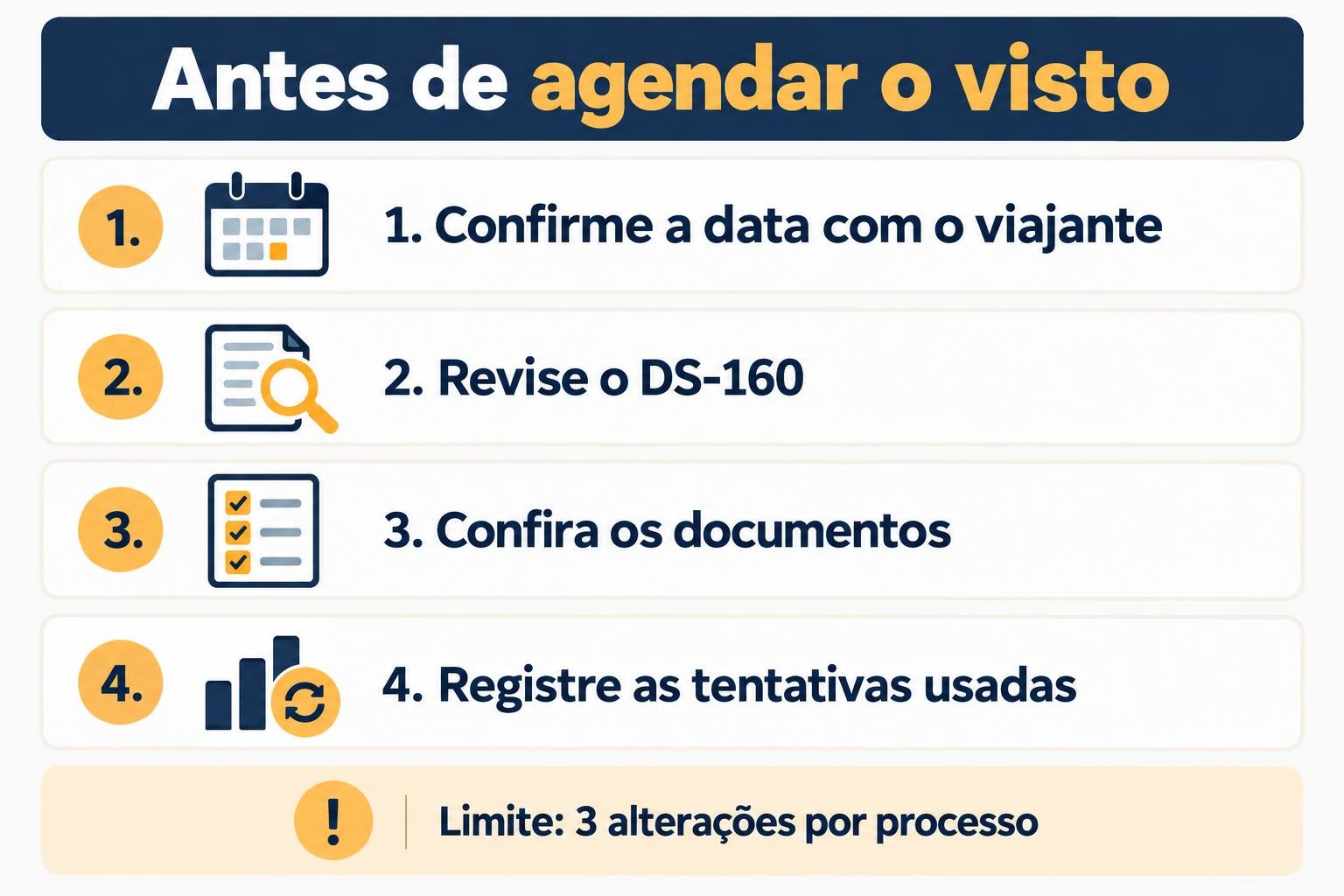
The safest approach is to schedule appointments only for confirmed dates and limit the number of attempts per employee. Here are six best practices:
- Schedule only for dates that have been confirmed. Confirm the trip with the traveler, the manager, and the project schedule before booking the interview.
- Track the number of attempts per employee. Record each change to the U.S. visa appointment rescheduling in a spreadsheet, including the name, appointment date, and number of changes made.
- Review the DS-160 before scheduling an appointment. The DS-160 is the online form used to apply for a nonimmigrant visa; check your name, dates, and passport information before proceeding.
- Check the documents. Gather your valid passport and the documents supporting the purpose of your trip before scheduling your interview.
- Designate a single person in charge. A single person should be in charge of scheduling for each traveler, so that no one changes the schedule without the other person's knowledge.
- Don't cancel just to check dates. Each cancellation uses up one of the three attempts.
These practices do not eliminate unforeseen circumstances, and the visa process requires attention to various details beyond simply scheduling an appointment.
How can I organize the rescheduling of U.S. visa appointments for large groups?
In large groups, it’s best to have a single point of contact, a shared calendar, and staggered schedules. This way, the company can prevent two people from working on the same task at the same time and wastes less time if there’s a bottleneck.
- Appoint a person to be in charge of each group of travelers.
- Schedule interviews on a staggered basis when positions become available, rather than scheduling the entire group for the same date.
- Leave some time between the interview date and the travel date to account for unforeseen circumstances.
- Start with the critical travelers—those with fixed-date projects—and review their documents first.
- Advise each traveler not to attempt to reschedule their U.S. visa appointment on their own.
Does the rule for rescheduling U.S. visa appointments apply to CASV?
It is not yet clear. CASV, which stands for Visa Applicant Service Center, is the in-person service center for the visa application process, and there is no official confirmation as to whether the limit of three changes also applies to this appointment.
Until further clarification is provided, the prudent course of action is to treat each CASV change as if it also counted as an attempt and to monitor announcements from the U.S. Consulate General in São Paulo.

What should you do if the U.S. visa rescheduling limit is reached?
If the limit is reached, the company must file a new application and pay the consular fee again. There is no way to change a blocked appointment, not even through customer support.
- Find out why the U.S. visa rescheduling quota has been reached, so you don't make the same mistake with other travelers.
- Review the DS-160 and your documents before scheduling a new appointment.
- Notify managers and departments that depend on the trip about the new possible date.
- Confirm the date with the traveler before finalizing the booking, and record the additional cost of the new fee.
Sources and Legal Basis
- U.S. Consulate General in São Paulo: Confirmation of the rule limiting cancellations or reschedulings to three per application, and a warning displayed in the scheduling system since the end of September 2026.
- U.S. Department of State: Official visa fee schedule, which lists the current fees for each category.
- Note: This is a rule of the U.S. consular appointment system, not a Brazilian law such as Law No. 13,445/2017 (the Immigration Law).
How Target Relocation Helps
Target Relocation is a Brazilian global mobility consulting firm that handles corporate immigration, documentation, and the relocation of foreign professionals. For HR, we assist with organizing the schedule, documents, and deadlines for international mobility, including managing the rescheduling of U.S. visas for each traveler, with a focus on compliance.
Learn about the Visa and Residency Consulting and expatriate management and relocation.
Frequently asked questions
How many times can you reschedule your U.S. visa interview?
The appointment scheduling system for U.S. consulates in Brazil allows a maximum of three interview cancellations or reschedulings per application. This limit applies to all visa categories and includes both cancellations and reschedulings. After that, the appointment is blocked, and the only option is to file a new application and pay a new fee.
Does canceling an interview count toward the U.S. visa rescheduling limit?
Yes. Cancellations and reschedules both count toward the same limit of three per booking. Therefore, avoid canceling just to test different dates or to decide later. Cancel only when you’re certain your travel plans have changed, and keep track of each change so you know how many attempts you have left.
What happens when you reach the limit for rescheduling a U.S. visa appointment?
The appointment is locked, and even customer support cannot reschedule the interview. You must file a new application and pay the consular fee again, which is US$185 for a B1/B2 visa. For other categories, refer to the U.S. Department of State’s official fee schedule.
Does the new rule apply to all types of visas?
Yes, the rule applies to all visa categories, as confirmed by the U.S. Consulate General in São Paulo. This includes tourist and business visas (B1/B2) as well as work visas. The alert has appeared in the appointment scheduling system since the end of September 2026.
Does the limit also apply to CASV?
There is still no confirmed clarification. CASV stands for Visa Applicant Service Center, and it is unclear whether the three-change limit applies to it. In the meantime, treat each change as if it counted as one attempt and stay tuned for updates from the consulate.
How should a company manage the rescheduling of U.S. visa appointments?
Assign one person to be responsible for each group of travelers and maintain a spreadsheet tracking the number of changes made per employee. Schedule appointments only for validated dates, and review the DS-160 and supporting documents before booking. This way, the company reduces the risk of having to pay a new consular fee and of delaying trips.
Does your company send teams abroad?
Contact Target Relocation and request a free mobility assessment to organize the timelines, documents, and risks associated with your relocation.