
The TR-L visa is Venezuela’s temporary work visa, granted to foreigners who will work in the country for a fixed period. The process has two steps: the hiring company obtains prior authorization from the Venezuelan Ministry of Labor, and then the professional applies for the visa at the consulate, presenting a valid passport and a criminal record certified with an apostille and translated.
Updated on · Content reviewed by the corporate immigration team at Target Relocation.
Key Points
- The TR-L visa requires two consecutive steps: prior authorization from the Venezuelan Ministry of Labor, followed by the visa application at the consulate.
- The hiring company plays a central role because the first step—obtaining a work permit—is handled by it.
- The most sensitive documents are a passport valid for at least 6 months and a criminal record, apostilled and translated into Spanish.
- There is no guaranteed timeline from a confirmed official source, so advance planning and expert advice make all the difference.
What is the Venezuelan TR-L visa?
The TR-L visa is a type of temporary work visa granted by Venezuela to foreigners who will be working in the country on a temporary basis. The letter “L” indicates that the visa is for work purposes.
In Spanish, the document appears as work transit visa or TR-L visa. In Portuguese, this process is known as a “work visa for Venezuela,” and that is what this guide refers to.
Also known as: temporary work visa, Venezuelan work visa, work visa from Venezuela.
For a company that sends or hires a foreign professional to Venezuela, the TR-L visa is the basis for legal employment in the country and the starting point for mobility planning.

What are the key details about the TR-L visa?
The table summarizes the key details of the process and indicates where to find information that changes frequently.
| Item | Information |
|---|---|
| Name | Worker Transit Visa (TR-L) from Venezuela |
| Prior Authorization | Ministry of the People's Power for the Social Process of Labor, or Venezuela's Ministry of Labor |
| Who requests the authorization | The contracting company |
| Where to Apply for a Visa | At the Venezuelan consulate with jurisdiction over the case |
| Key Documents | A passport valid for at least 6 months; a criminal record certified with an Apostille and translated into Spanish |
| Legal Basis | Venezuelan immigration and labor laws; check the current regulations through official channels |
| Typical timeframe | No official deadline has been confirmed; check for updates at the Ministry and the consulate |
| Cost | Amount updated in the tables of Venezuelan government agencies |
Who needs a TR-L visa to work in Venezuela?
Foreign nationals who plan to work in Venezuela need this visa if they do not have another immigration status that authorizes them to work.
The most common scenario involves expatriates: professionals are sent by a company, transferred between units within the same group, or hired by a Venezuelan company. Entering the country as a tourist to work is not a standard procedure.
The analysis depends on nationality, job title, and employment status. Therefore, before beginning the process, check with the relevant Venezuelan authorities to see if any specific rules apply to your case.
How does the two-step TR-L visa process work?
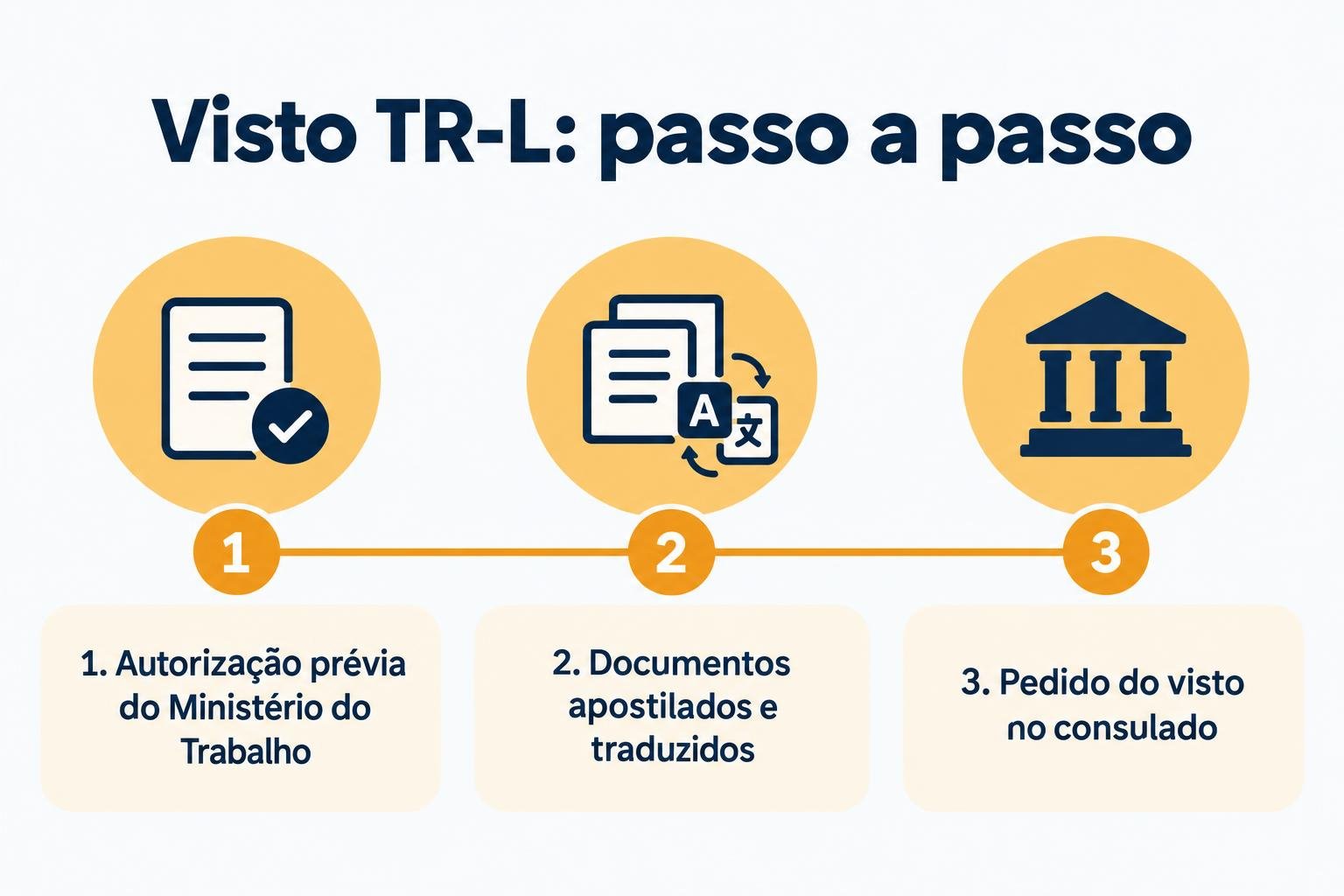
The TR-L visa process consists of two consecutive steps: first, obtaining prior authorization from the Venezuelan Ministry of Labor, and then applying for the visa at the consulate.
- Prior authorization. The contracting company submits the application to the Ministerio del Poder Popular para el Proceso Social del Trabajo, the Venezuelan government agency responsible for labor matters.
- Professional documentation. The professional must provide a valid passport and a criminal record certified with an Apostille and translated into Spanish. This step can be carried out at the same time as the first one.
- Application at the consulate. With prior authorization, the professional applies for a visa at the appropriate Venezuelan consulate.
- Registration and enrollment. After arriving in Venezuela, the company and the professional must comply with local immigration requirements as set forth by the authorities, such as SAIME (Administrative Service for Identification, Immigration, and Foreigners).
The process goes through several stages, and each has its own requirements. A mistake at one stage can delay the subsequent ones. In the practice of mobility projects, what matters most is coordination among the different levels. Treating the process as a project—with designated leads and a timeline—works better than addressing each requirement as it arises.
What is the role of the hiring company in the TR-L visa?
The hiring company initiates the process because prior authorization from the Venezuelan Ministry of Labor must be obtained before applying for a visa at the consulate.
This means that the professional relies on the company to complete the first step. It is up to the company to gather the required corporate documentation, monitor the process at the Ministry, notify the professional when the authorization is available, and align the start date of the professional’s activities with the actual progress of the process.
For HR or the Mobility team, this has implications for planning: include the TR-L visa in the timeline as soon as the decision is made to send the employee abroad. The same applies to the entire expatriate cycle, which is the subject of expatriate management and relocation.
What documents does a professional need to apply for a TR-L visa?
The key documents required for the TR-L visa are a passport valid for at least 6 months and a criminal record, apostilled and translated into Spanish.
- Passport: Valid for more than 6 months. If your passport is about to expire, renew it before starting the process.
- Criminal history: a certificate issued by the competent authority, bearing an Apostille and translated into Spanish.
- Supplementary documents: documents required by the Venezuelan Ministry of Labor and the consulate, such as information about the hiring company and the employment relationship.
The complete list may vary depending on nationality, the consulate, and updates to the regulations. Be sure to check it before issuing any certificate, as some documents may have expiration dates and may expire before the request is processed.

How do I apostille and translate TR-L visa documents?
An apostille is a certificate issued under the 1961 Hague Apostille Convention that certifies the authenticity of a public document for use in another country. Venezuela is a party to this convention, which is why criminal records undergo this procedure.
In Brazil, apostille certification is performed at an authorized notary’s office. After the apostille is issued, the document is translated into Spanish. Check with the consulate to see if it accepts certified translations done in Brazil and what format it requires. To understand each step, see the guide on Hague Apostille and content about Certified translation for immigration purposes.
A missing handout or an incomplete translation may require you to redo documents and delay your TR-L visa.
How long does it take to get a TR-L visa, and how much does it cost?
The processing time for a TR-L visa varies depending on the Venezuelan Ministry of Labor’s review, the consulate’s availability, and the quality of the documentation; there is no guaranteed processing time from a confirmed official source.
A practical tip is to plan with plenty of time to spare and not set a start date for activities until the authorization and visa have been issued. Track the progress directly through the Ministry’s and the consulate’s channels.
Fees are charged by Venezuelan government agencies, and the current amount should be confirmed through official channels. When preparing your budget, also consider the costs on the Brazilian side, such as certification, translation, and document shipping.
What mistakes can delay a TR-L visa?
The mistakes that pose the greatest threat to the schedule are in documentation and planning, not in the rule itself.
- A passport valid for 6 months or less.
- Criminal records without an annotated copy or a translation into Spanish.
- Applying for a visa at the consulate before receiving prior authorization from the Ministry of Labor.
- Certificates issued too early, which expire before the request is made.
- Start date of employment determined before the visa is issued.
- A lack of coordination among the various levels of government, which leaves pending issues with no one assigned to handle them.
The availability of consular services also depends on the diplomatic relationship between the countries. Check to see if the consulate is open before planning trips or moves.
What changes for the company and for the employee?
For the company, the TR-L visa is a matter of immigration compliance: the employee should not begin working in Venezuela until their status has been regularized.
For professionals, the key considerations are the company’s support during the initial phase and responsibility for personal documents, such as passports and criminal records. It is also worth consulting with the tax and benefits departments to assess the effects of moving to another country on compensation and taxes.
How does Target Relocation help?
Target Relocation is a Brazilian global mobility consulting firm that handles corporate immigration, documentation, and the relocation of foreign professionals. For projects involving the TR-L visa, the team helps organize the planning, the document checklist, the apostille, the translation, and coordination between the company and the professional. Learn more about Visa and Residency Consulting.
Frequently asked questions
What is the Venezuelan TR-L visa?
This is Venezuela’s temporary work visa, granted to foreigners who will be working in the country on a temporary basis. The process involves two steps: prior authorization from the Venezuelan Ministry of Labor, requested by the hiring company, and the professional’s application for the visa at the consulate, along with the required documentation.
Who applies for the work visa: the company or the employee?
Both parties are involved. The hiring company must first request prior authorization from the Venezuelan Ministry of Labor, and only then can the professional apply for a visa at the consulate. Therefore, the professional is dependent on the company’s progress during the first stage and must coordinate the timeline with HR or the relevant advisory team.
What documents are required for a work visa in Venezuela?
The main requirements are a passport valid for at least 6 months and a criminal record certified with an Apostille and translated into Spanish. The Venezuelan Ministry of Labor and the consulate may request additional documents, such as company records and proof of employment. Check the current list on official channels before issuing any certificates.
How long does the process take?
There is no guaranteed timeline from a confirmed official source. The timeframe depends on the Venezuelan Ministry of Labor’s review, the consulate’s availability, and the quality of the documentation. Plan with plenty of time to spare, and do not set a start date for your activities until the authorization and visa have been issued.
Do I need to have the documents apostilled and translated?
Yes, criminal records must be apostilled and translated into Spanish. In Brazil, the apostille is issued by an authorized notary public. Before translating the documents, check with the consulate to confirm the accepted format—such as a certified translation—to avoid having the documents rejected.
Sources and Legal Basis
- Ministry of the People's Power for the Social Process of Labor (Venezuela): the agency responsible for issuing prior work authorization.
- Administrative Service for Identification, Migration, and Foreigners (SAIME): Venezuela's immigration authority.
- Venezuelan immigration laws, particularly the Ley de Extranjería y Migración.
- The Hague Apostille Convention (1961), which governs the apostille of public documents.
- Competent Venezuelan Consulate: Guidelines and Current List of Documents.
The rules for the TR-L visa are subject to change. Always check the official channels of the Venezuelan government and the consulate before beginning the process.
Are you going to send a professional to Venezuela?
Plan your work visa well in advance. Request a free mobility assessment from Target Relocation to understand the steps, required documents, and timeline for your case.