
Sending an expatriate to Venezuela requires addressing, in this order, the employment contract, the work permit and visa, the foreigner’s ID card issued by SAIME (the Venezuelan Identification and Migration Service), security, currency exchange, and payroll. Each step depends on the previous one, so HR must put together the complete plan before purchasing the first ticket.
Updated on · Content reviewed by the corporate immigration team at Target Relocation.
Key Points
- An expatriate in Venezuela may be assigned under a Brazilian contract, governed by Law No. 7,064/1982, or under a local contract, and this choice determines the obligations, rights, and applicable law.
- SAIME (Administrative Service for Identification, Migration, and Foreigners) is the Venezuelan agency that registers foreign residents and issues foreigner ID cards.
- Brazilian certificates and diplomas usually require a Hague Apostille and a translation into Spanish before any visa application can be submitted.
- Safety, health, housing, and currency exchange require a specific plan, because the company has a duty of care toward its employees abroad.
- The sanctions regime—particularly the U.S. sanctions on the Venezuelan oil sector—must be reviewed by the legal department before the first professional is assigned to the project.
Also known as: Expatriation to Venezuela, international assignment to Venezuela, professional transfer to Venezuela, and international mobility to Venezuela.
| Item | What You Need to Know |
|---|---|
| Venezuelan immigration agency | SAIME (Administrative Service for Identification, Migration, and Foreigners) |
| Brazilian Legal Basis for the Employment Relationship | CLT (Art. 469) and Law No. 7,064/1982 |
| Who determines visas and permits? | Venezuelan authorities, through the appropriate consulate |
| Who can be sent | Employee who formally consents to the transfer |
| Typical timeframe | This varies depending on the type of visa, the consulate, and the requirements of the relevant agencies; please check directly with them |
| Key Documents | Passport, apostilled and translated certificates and diplomas, invitation letter or contract; current list available at the consulate |
| Cost | Consular and SAIME fees in accordance with the current fee schedules of Venezuelan government agencies |
Why Should HR Reevaluate Expatriates in Venezuela Now?
HR should reassess expatriates in Venezuela because the prospect of a recovery in the oil sector has put the country back on the radar of energy, mining, engineering, and service companies. Where there is a new contract, there is demand for professionals in the field, and the timeframe for mobilizing them is usually short.
The decision, however, is not purely business-related. Sending an expatriate to Venezuela depends on permits, immigration rules, and a support structure that many companies have stopped maintaining in recent years.
The sanctions regime—particularly the U.S. sanctions on the Venezuelan oil sector—operates through general and specific licenses that change frequently. The company’s legal department must verify that the transaction complies with the regulations before taking any action, including payments and supplier arrangements.
That’s why HR gets involved early in the project. By developing the mobility plan before the contract is signed, HR ensures that the business timeline doesn’t outpace the ability to deploy people safely and in compliance with regulations.

What is the process for preparing an expatriate to work in Venezuela?
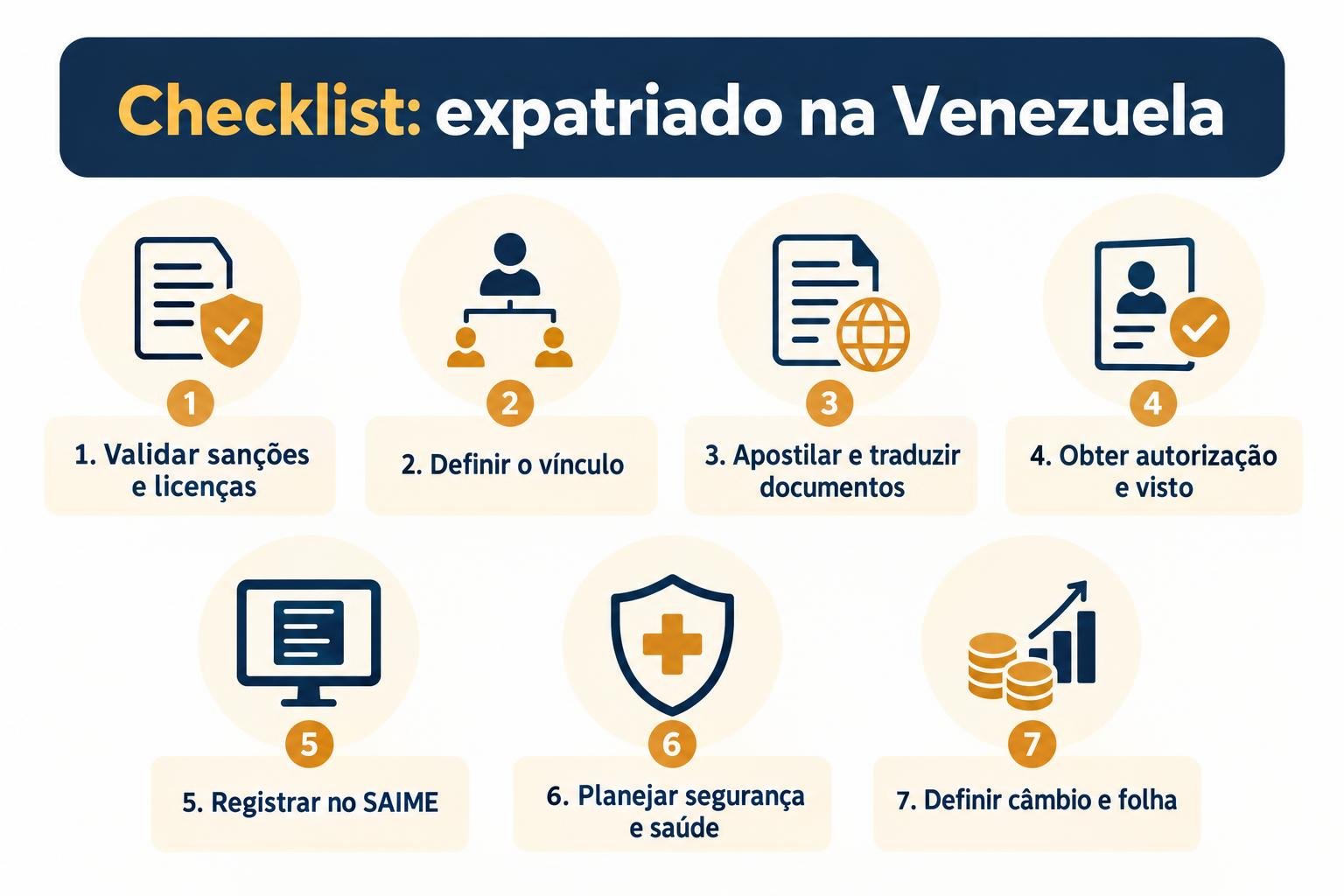
The process for preparing an expatriate to work in Venezuela consists of eight steps, and the order is important because each step paves the way for the next:
- Validate the transaction: penalties, licenses, and terms of the contract with the customer.
- Define the employment relationship: Brazilian contract with a transfer or local contract.
- Obtain the professional's formal consent and make a decision regarding the family.
- Gather the documents and arrange for the certification and translation.
- Apply for a work permit and visa at the Venezuelan consulate.
- Register the professional with SAIME and obtain a foreigner's ID card.
- Organize housing, safety, health, and transportation.
- Set up foreign exchange, payroll, and tax obligations.
Processing times vary by stage, by consulate, and depending on the workload of the relevant agencies. Work backward from the date the professional needs to be on-site, and confirm each deadline with the appropriate Venezuelan consulate and the local office.
How should an expatriate's employment relationship in Venezuela be structured?
An expatriate’s employment arrangement in Venezuela takes one of two forms: a transfer under the original Brazilian contract or a local contract. The choice affects the applicable law, payroll taxes, and guarantees of return.
Law No. 7,064/1982 governs the status of workers hired in Brazil or transferred by their employers to provide services abroad. In general terms, it ensures the application of Brazilian labor protection laws when they are more favorable and provides for rights related to returning to Brazil.
Article 469 of the CLT prohibits transferring an employee, without his or her consent, to a location other than that specified in the contract when there is a change of residence. In practice, an employee assigned to Venezuela must sign a consent form and a contract amendment specifying the position, compensation, duration, and conditions for return.
| Criteria | Brazilian Contract (Law No. 7,064/1982) | Local Contract |
|---|---|---|
| Applicable Law | Brazilian law, where it is more favorable, combined with the rules of the destination country | Venezuelan Labor Laws |
| Employment Relationship in Brazil | Retained, with an amendment | Suspended or terminated, depending on the legal framework |
| Return | As provided for in the amendment and in the law | It depends on what is negotiated |
| Greater complexity | Payroll, Taxes, and Social Security in Brazil | Local charges and fees |
Before making a decision, seek the advice of a Brazilian labor attorney and a local law firm. The right combination depends on the position, the duration of the project, and the contract with the client.
What permits and documents does an expatriate in Venezuela need?
Expatriates in Venezuela need a work permit and a visa appropriate for their activity—both of which are determined by Venezuelan authorities—as well as a foreigner’s ID card issued by SAIME. The correct category depends on whether the stay is short-term, such as a technical visit, or a residence tied to employment.
A technical visit and a residency are not the same thing. Using a short-term visa category for a long-term stay exposes both the professional and the company to administrative penalties and problems entering and leaving the country.
Check with the appropriate Venezuelan consulate and the local office for the most up-to-date list of documents, deadlines, and fees. These requirements change, and the agencies’ actual practices do not always match what is published.
What documents are usually requested?
In immigration cases of this type, the following are typically requested:
- a passport with a long validity period;
- criminal record certificate;
- birth and marriage certificates for dependents;
- degree and proof of professional experience;
- letter of invitation or contract from the company in that country;
- medical exams and photographs, as required by the consulate.
How do I have documents apostilled and translated?
Brazilian public documents are typically legalized through the Apostille process and then translated into Spanish by a certified translator. Brazil and Venezuela are signatories to the Hague Apostille Convention, which eliminates the need for consular legalization. Step-by-step instructions can be found in the guide on Hague Apostille for Expatriates' Documents.
The company also needs to track the validity of documents, authorized activities, and renewals. Information about migration compliance It shows how to manage this process and reduce legal risks. This advice applies to the first expatriate in Venezuela as well as to subsequent ones.
How can you ensure housing, safety, and health for expatriates in Venezuela?
Housing, safety, and health for expatriates in Venezuela require a formal plan before departure, because the company has a duty of care toward the employees it sends abroad.
- Security: Conduct a risk assessment by region and by route, hire transportation with a reliable driver, establish communication protocols and an evacuation plan. Stay informed about alerts from the Ministry of Foreign Affairs.
- Health: Purchase international insurance that includes medical evacuation, check your access to medications and medical appointments, and follow the health authorities’ guidelines on vaccination.
- House: Opt for a formal lease agreement for a safe property and verify the reliability of electricity, water, and internet service, which may require specific solutions.
- Family: Assess whether dependents will accompany the professional, taking into account school, medical care, and the duration of the project. One option is to send the professional alone at first and then reassess whether the family should join later.
A expatriate management and relocation It brings all these points together into a single plan, from departure to return.

How should exchange rates, payroll, and taxes for expatriates in Venezuela be handled?
Determining an expatriate’s compensation in Venezuela requires decisions regarding currency, payment location, and taxation, because the country has its own local currency, the bolívar, a history of exchange controls, and many transactions in foreign currency.
Work with the finance department, local banks, and local attorneys to:
- in which currency and in which country the salary and living allowance will be paid;
- how the professional will access resources and payment methods on a day-to-day basis;
- which remittance and foreign exchange control rules apply;
- such as the Brazilian payroll and how the related charges will be handled in the selected contract.
In Brazil, moving abroad to work may change a professional’s tax residency, depending on the length of absence and notification to the Federal Revenue Service. In Venezuela, income taxation depends on residency and length of stay. Without proper planning, professionals may face double taxation or issues with filing tax returns.
Also check your social security coverage: contributions to the INSS and any social security agreements between the countries. The tax consulting for expatriates It helps estimate the total cost of the expatriate assignment in Venezuela before signing the amendment.
What mistakes cause the most delays for expats in Venezuela?
The mistakes that most often hold up expatriates in Venezuela are decisions made out of order, rather than isolated errors:
- contact the employee before approving disciplinary actions and leaves of absence;
- use the "visit" category for work-related residency activities;
- submit documents without an apostille or with a non-standard translation;
- fail to formalize the consent and the contract amendment;
- buy tickets before obtaining authorization and a visa;
- Treat security, medical evacuation, taxes, and social security as matters to be addressed after boarding.
How Target Relocation Helps
Target Relocation is a Brazilian global mobility consulting firm that handles corporate immigration, documentation, and the relocation of foreign professionals. For companies considering sending an expatriate to Venezuela, the team organizes the mobility plan, manages documents, certifications, translations, and deadlines, and oversees the professional’s relocation. It also advises on when to involve local attorneys and specialists.
Frequently asked questions
Can a company send an employee to Venezuela?
Yes, provided that the company complies with Venezuelan immigration rules, Brazilian labor laws, and the sanctions regime applicable to the operation. The employee must consent to the transfer (Art. 469 of the CLT), and the contract must specify the chosen arrangement. Without these points in order, sending an expatriate to Venezuela exposes the company to risks.
What kind of visa does a professional need to work in Venezuela?
The type of visa depends on the nature and duration of the activity and is determined by the Venezuelan authorities. Short-term visits and work-related residency fall under different categories. Consult the appropriate Venezuelan consulate and a local office before beginning the application process, and confirm the current list of required documents.
What is the SAIME foreigner ID card?
It is the identification document issued by SAIME—the Venezuelan Service for Identification, Migration, and Foreigners—to foreign residents. Generally, the company arranges for the expatriate’s registration in Venezuela shortly after arrival, because the document serves as proof of the professional’s identity in daily life and for local administrative procedures.
How long does it take to prepare an expatriate for Venezuela?
The processing time varies depending on the type of visa, the consulate, the workload of the relevant agencies, and how quickly you can gather the apostilled and translated documents. There is no single, reliable processing time. Plan your schedule in reverse, starting from your start date in the field, and don’t buy your tickets until you’ve received authorization.
Does Law No. 7,064/1982 apply to people who go to work in Venezuela?
The law applies to workers hired in Brazil—or transferred by their employers—to provide services abroad, without restricting the destination country. For this reason, it serves as the basis for drafting a Brazilian contract for an expatriate in Venezuela, with the assistance of a labor attorney.
Sources and Legal Basis
- CLT (Decree-Law No. 5,452/1943), Art. 469, on the transfer of employees.
- Law No. 7,064/1982: Workers hired or transferred to provide services abroad.
- SAIME (Venezuela): Agency for Identification, Migration, and Foreigners; current requirements must be confirmed with the agency and the consulate.
- U.S. Department of the Treasury (OFAC): Licenses and Sanctions Related to the Venezuelan Oil Sector.
Are you going to send the first professional to Venezuela?
Contact Target Relocation and request a free relocation assessment to organize your employment arrangements, documents, deadlines, and follow-up before departure.