
Bank Accounts for Foreigners in Brazil: A Step-by-Step Guide to Opening One
Yes, foreigners can open a bank account in Brazil. To do so, they must have a CPF number and a valid identification document, such as the National Migration Registry. The type of account depends on whether the foreigner is a resident or non-resident of the country.
Opening a bank account may seem like a minor detail when an expat first arrives. In practice, it’s one of the first hurdles. Without an account, the professional can’t receive their local salary, can’t easily pay rent, and can’t get their finances in order. Not having a CPF brings everything to a standstill before it even begins.
This guide explains how bank accounts for foreigners in Brazil work. You’ll learn the difference between residents and non-residents. You’ll also find out what documents are required, the step-by-step process for opening an account, and the central role of the CPF throughout the process.
Can a foreigner open a bank account in Brazil?
Yes, Brazilian law allows foreigners to open an account. The key factor is not nationality. What matters is the foreigner’s status in the country and the documentation they provide. With the correct documents, the account-opening process follows the standard procedure.
The first requirement is always the CPF. The Individual Taxpayer Registry identifies individuals with the Federal Revenue Service. Without a CPF, the bank cannot open an account. For this reason, the CPF is usually the first document that new arrivals in Brazil need to obtain.
The second requirement is a photo ID. For foreign residents, the standard document is the CRNM, or National Migration Registry Card. In some cases, the CRNM application form is already accepted. The bank also requires proof of income and proof of residence.
It’s worth pointing out one point that often causes confusion. Holding a tourist visa does not place a foreign national in the same situation as a resident. As a general rule, tourists do not open a standard resident account. They are subject to the rules for non-resident accounts, which have their own restrictions.
What is the difference between a resident and a non-resident?
The distinction between residents and non-residents is at the heart of this issue. It determines the type of account, the required documents, and the rules governing account transactions. Confusing the two scenarios is the most common reason for an application to be denied. Here’s how each case works.
Resident Alien Account
A resident alien is someone who holds a residence permit in Brazil. He obtained the appropriate visa, entered the country, and registered with the Federal Police. With his CRNM and CPF in hand, he opens a regular bank account, just like any Brazilian resident.
In this scenario, the account operates without any special restrictions. The professional receives a salary, manages funds, and uses local financial services. This is the typical situation for an expatriate who has come to work in Brazil. The only thing to keep in mind is to ensure that immigration documentation is in order.
Non-resident foreigner's account
A non-resident foreigner lives outside Brazil or is in the country on a temporary basis. He or she may also have an account in reais. The rules governing these accounts have changed under the new foreign exchange framework and are now simpler than many people realize.
The legal basis is the Lei 14.286/2021, the Brazilian foreign exchange framework. According to Article 5, paragraph 4, accounts denominated in reais held by non-residents are treated the same as those held by residents, subject to any requirements and procedures established by the Central Bank. The regulations are set forth in BCB Resolution 277/2022, which addresses real-denominated accounts held by non-residents.
In practice, this means that the bank can open and maintain the account under the same conditions as a regular account, subject to the specific requirements of the Central Bank. Institutions authorized to operate in the foreign exchange market offer this type of account. Even so, the background check is usually more thorough because the account holder is not a resident of the country.
What documents are required to open an account?
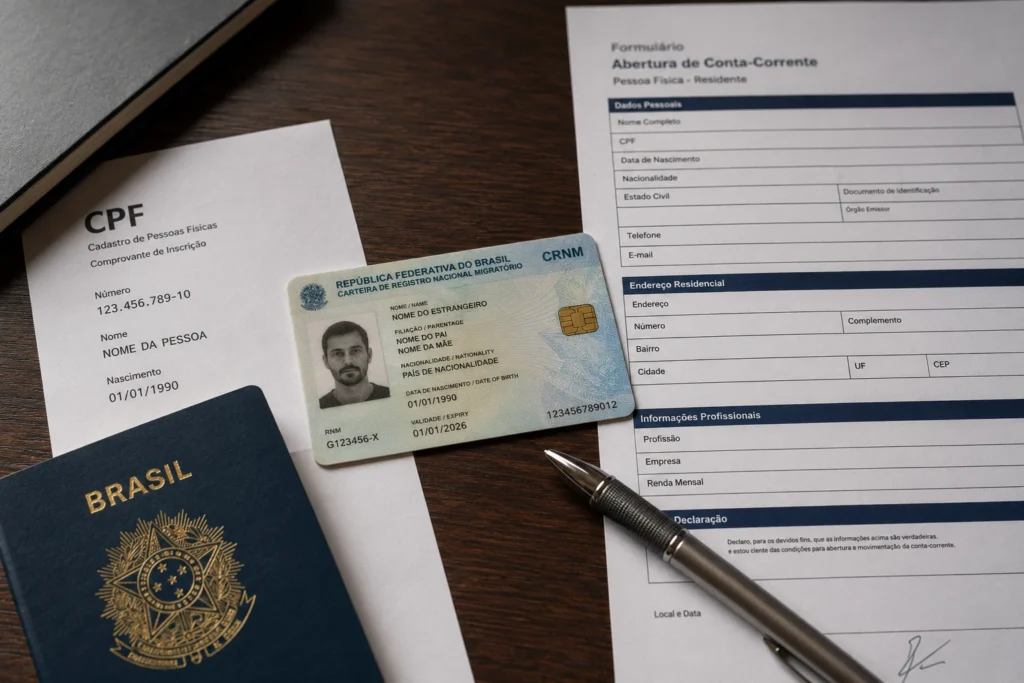
The list of required documents varies depending on the bank and the foreign national’s profile. Even so, there is a core set of documents required in most cases. Gathering everything before going to the branch saves you from having to make multiple trips. Here are the most commonly requested documents for foreign residents.
- Valid and in good standing CPF
- Photo ID, such as the CRNM or the application form
- Proof of residence in Brazil
- Proof of income or employment
- A valid passport, when requested as supplementary identification
Proving proof of residence can be a challenge at first. Newly arrived expats don’t always have an electricity bill in their own name. In such cases, lease agreements and tax returns can help. Each bank determines which forms of proof it accepts.
Proof of income also warrants attention. An employee transferred by the company may use the job offer or the employment contract. Documents issued abroad, when required, may need to be certified by a sworn translator. This documentation process is outlined in the Certification, translation, and CPF services for expatriates.
Step-by-Step Guide to Opening a Bank Account as a Foreigner
Once the documentation is in order, the account opening process follows a predictable sequence. The steps below apply to foreign residents, which is the most common scenario for expatriates. Following the correct order reduces the risk of rejection at the branch. Opening a bank account for foreigners follows this process.
- Get your CPF number. It's the first step, and it unlocks everything else.
- Regularize your immigration status. Register with the Federal Police and obtain your CRNM.
- Gather the required documents. Include your ID, proof of residence, and proof of income.
- Choose a bank. Compare fees, multilingual customer service, and digital services.
- Open the account. Submit the documents at a branch or through the bank's online portal.
- Activate the services. Set up your card, online banking, and direct deposit.
Each bank has its own review policies. Some have departments dedicated to international customers. Others require in-person service when opening an account for the first time. Checking these requirements in advance saves time, especially for those who arrived just a few days ago.
Consulting firms such as Target Relocation, which serves more than 70 multinational companies, include opening a bank account as part of the expatriate’s arrival package. The CPF, immigration registration, and supporting documents are organized in sequence. This way, the professional doesn’t waste time on avoidable delays.
Why is the CPF the first step?
The CPF is the key to financial life in Brazil. It identifies individuals in nearly all economic transactions. Without it, you cannot open a bank account, sign a formal contract, or make an investment. That is why it tops any checklist for newcomers. Without a CPF, foreigners cannot open a bank account.
The Federal Revenue Service itself makes this clear. Foreigners who own, or intend to own, assets and rights subject to public registration in Brazil must register for a CPF number. This includes bank accounts and investments in the financial market. Registration can be completed through the Federal Revenue Service’s CPF registration service for foreigners.
The CPF has another important feature. It is unique and permanent. Once assigned, the number stays with the person for life. There is no such thing as a second CPF. Therefore, anyone who already had a CPF during a previous stay in Brazil must reactivate it, not create a new one.
For expatriates, the practical lesson is clear. You should obtain your CPF as soon as possible—often while still abroad. Brazilian consulates issue CPFs in various situations. Arriving in Brazil with your CPF already in hand speeds up the process of opening a bank account and settling in.
Common Mistakes and How Relocation Can Help
There are some common mistakes foreigners make when opening a bank account. Being aware of them helps prevent problems and reduces frustration. Most of these mistakes stem from rushing or failing to follow the steps in the correct order. Here are the most common mistakes.
- Trying to open an account without a CPF. That's the number one mistake, and it brings everything to a halt.
- Confusing "resident" with "non-resident." This leads to choosing the wrong type of account.
- Not having proof of residence. This is common among new arrivals.
- Use only your passport as identification. Many banks require the CRNM or the protocol.
- Ignore required translations. Foreign documents may need to be certified.
This is where relocation makes a difference. The relocation service organizes the expatriate’s arrival in a logical sequence. First, immigration paperwork. Then the CPF. Next, housing, supporting documents, and a bank account. Each step leads seamlessly into the next.
In practice, consulting firms such as Target Relocation treat the bank account as part of the settling-in package, rather than as a separate item. The proof of residence obtained during the housing phase, for example, is usually the same document the bank will require later. Linking these steps prevents the expatriate from being left without access to funds during the first few weeks.
This sequence of steps is more important than it seems. A professional who is still regularizing their stay under a work-related framework—such as the one described in the guide on technical visas—needs to ensure that their account is in line with their immigration status. Doing things in the right order prevents rejections and rework.

Is a digital bank account an option for foreigners?
Yes, digital bank accounts have changed the landscape for foreigners in Brazil. Many digital banks allow you to open an account using your cell phone, with documents submitted via an app. This reduces the need to visit a physical branch. For newly arrived expats, it’s a real convenience.
Even so, the basic requirements remain the same. The CPF is still mandatory. Photo ID and proof of residence are still required. Technology streamlines the process, but it does not eliminate the need for supporting documentation or valid immigration status.
There is one thing to keep in mind regarding digital accounts. Not all of them readily accept foreign identification documents. Some platforms are designed specifically for the Brazilian market. Therefore, it’s worth checking whether the digital bank you’ve chosen accepts the CRNM and serves international customers before attempting to open an account.
The choice between a traditional bank and a digital bank depends on your profile. Those who value in-person service and service in other languages may prefer a branch. Those who prioritize speed and independence tend to choose digital banking. Many expatriates combine the two, with a primary account and a secondary digital account.
How long does it take to open an account?
The time it takes to open an account varies depending on the bank and the documentation required. With your CPF, CRNM, and supporting documents ready, the account can be opened in just a few days. Through digital channels, the review process is sometimes even faster. The bottleneck is almost never the bank itself, but rather the required documentation.
What usually causes delays is the previous step. Obtaining a CPF, completing registration with the Federal Police, and getting proof of residence takes time. These steps take place before the professional arrives at the service counter. When they are handled in parallel, the total processing time is significantly reduced.
That’s why planning for your arrival makes such a difference. An expat who arrives with a CPF already issued and housing arranged can open a bank account quickly. On the other hand, those who leave everything to be sorted out later face a series of pending issues. The order in which you complete these steps determines how quickly you’ll see results.
Frequently Asked Questions About Bank Accounts for Foreigners
Do foreigners need a CPF to open a bank account in Brazil?
Yes. A CPF number is required to open a bank account in Brazil. It identifies the individual with the Federal Revenue Service and is required by all banks. Foreigners who wish to have an account or make investments in the country must register for a CPF number. The number is unique and permanent. Obtaining your CPF early—sometimes even while still abroad—speeds up the account-opening process.
What is the difference between a resident account and a nonresident account?
A resident account is opened by a foreign national with a residence permit and a CRNM. It operates without any special restrictions, just like a Brazilian’s account. Non-resident accounts are governed by the foreign exchange framework established by Law 14.286/2021 and BCB Resolution 277/2022, which ensure treatment equivalent to that of resident accounts, except for specific requirements defined by the Central Bank. The individual’s immigration status determines which account applies.
What documents are required to open an account?
For foreign residents, the standard documents are the CPF, a photo ID such as the CRNM or a temporary ID number, proof of residence, and proof of income. A passport may be requested as supplementary identification. Foreign documents may require a certified translation. Each bank sets its own requirements, so it’s a good idea to check the list beforehand.
Can tourists open a bank account in Brazil?
As a general rule, tourists do not open a standard resident account. They do not have a residence permit or a CRNM. In such cases, the non-resident account system applies, with specific rules set by the Central Bank and restricted transaction limits. Those who come to work must regularize their immigration status before applying for a standard resident account.
Can an expatriate open a bank account as soon as they arrive?
It depends on the documentation. Those who arrive with a CPF and whose immigration status is already in process move through the process more quickly. The bottleneck is usually proof of residence and the CRNM. That’s why the relocation service organizes the sequence of steps. This way, housing, documents, and a bank account all fall into place without one pending issue holding up another.
Conclusion
It is possible and straightforward for a foreigner to open a bank account in Brazil. The key is to follow the steps in the right order: CPF, valid immigration status, supporting documents, and then the account. When this sequence is followed, the process goes smoothly without any major obstacles.
The distinction between residents and non-residents is the basis for the entire process. Residents open a regular account. Non-residents must follow specific rules set by the Central Bank. Understanding which category a foreigner falls into helps avoid the most common reason for rejection by banks. That is the key to opening a bank account for foreigners.
As part of the move to Brazil, opening a bank account is a symbolic milestone. It signals that the relocation is progressing and that your financial life in Brazil has begun. With proper planning and all documentation in order, this step ceases to be an obstacle and becomes just another milestone achieved. Opening a bank account for foreigners becomes just another milestone achieved.