A common-law marriage for foreigners is one of the legal grounds that entitles them to a residence permit in Brazil. When a foreigner proves a relationship with a Brazilian citizen or a resident, they may apply for a residence permit on the basis of family reunification. The application is processed by the Federal Police.
For international HR departments and the family itself, this process often raises questions. Many believe that only a formal marriage guarantees residency. Brazilian law, however, recognizes a common-law marriage as a valid family relationship, including between people of the same sex. Ignoring this can delay the dependent’s legalization.
This guide explains how common-law marriage works for foreigners, who is eligible, what documents the Federal Police require, and how it differs from marriage. The focus is on providing legal clarity to those who need to regularize the status of an expatriate’s spouse or partner.
What is a common-law marriage for foreigners in the context of immigration?
A common-law marriage is the legal recognition of a public, continuous, and long-term cohabitation between two people, with the aim of forming a family. In the context of immigration, it serves as the basis for a residence permit granted for family reunification.
The Immigration Law treats spouses and partners in a common-law relationship equally. What matters is the existence of a proven family relationship. Therefore, couples who are not legally married can also obtain residency through this process.
Residence for the purpose of family reunification is provided for in the Law No. 13,445 of 2017, the Migration Law, which recognizes family ties as the basis for a residence permit. The provision covers spouses, partners, children, and other dependents, in accordance with legal criteria.
Who is eligible to apply for residency based on a common-law marriage?
This law applies to foreign nationals who are in a stable relationship with an eligible person. Regularization depends on proving the relationship and cohabitation. It is not enough to simply declare the relationship; it must be supported by documentation.
The following individuals may apply for residency on this basis:
- Partner of a Brazilian citizen.
- Partner of a foreign national who already has permanent residency in Brazil.
- Couples of different sexes or of the same sex.
- Families with children in common, which strengthens the evidence of the relationship.
Does a common-law marriage need to be registered before filing the petition?
Recognition of a common-law marriage is typically formalized through a notarized deed. This document is one of the strongest pieces of evidence of the relationship. In many cases, it is required to support a residency application.
When a couple does not have a deed, other evidence may be considered. Joint bank accounts, a lease in both their names, and witness statements can help demonstrate that they are living together. The law firm handling the case usually advises on which set of evidence is most compelling for the specific situation.
How does the application for a residence permit based on family reunification work?
The application for a common-law marriage follows the same procedure as that for a residence permit based on family reunification. It is submitted to the Federal Police, the agency responsible for receiving the documentation, reviewing the relationship, and registering the residence. The Ministry of Justice and Public Security is the immigration authority.
The process varies depending on whether the foreign national is inside or outside Brazil. Those already in the country file their application directly. Those abroad can begin by applying for a consular visa based on family reunification.
The country's immigration regulations are centralized in the Immigration Portal of the Ministry of Justice and Public Security, which compiles the regulations, resolutions, and the Immigration Act. It is the official reference for staying up to date on residency and family reunification.
General step-by-step overview of the process:
- Gather evidence of your common-law marriage.
- Gather the personal documents of the foreign national and their partner.
- Have documents issued abroad apostilled and translated.
- File the request with the Federal Police or through the consulate.
- Follow the review process until the authorization and RNM are issued.
In processes handled by consulting firms such as Target Relocation, the checklist begins with verifying the partner’s relationship status and eligibility. This precaution prevents the submission of a weak application, which could be subject to additional requirements or rejection.
[IMAGE: Federal Police immigration counter showing a foreign national handing over a folder of documents. ALT TEXT: “Foreign national files an application for a residence permit based on a common-law marriage with the Federal Police.” FORMAT: WebP]
What documents are required for a common-law marriage involving foreign nationals?
The documentation includes proof of family ties and personal documents. Each item must be consistent, and if issued outside Brazil, it must be properly legalized. Inconsistencies are the main reason for additional requirements during the process.
Documents typically requested:
- The foreign national's identification document and passport.
- Proof of a common-law marriage, such as a notarized deed.
- Joint Statement on Continuing to Live Together.
- Certificates of civil status for the individuals involved.
- Documents from the Brazilian partner or resident.
Foreign documents usually require an Apostille under the Hague Convention and a certified translation. This requirement links the application to the apostille and sworn translation solutions that are part of family immigration proceedings. Without this step, the Federal Police may not accept the documentation.
How long does it take to process the request?
The processing time varies depending on the Federal Police unit and the volume of requests in the jurisdiction. There is no single processing time guaranteed by law. Well-documented cases tend to be processed with fewer requirements and, therefore, with greater predictability.
The organization of documents directly affects the processing time. When evidence of the relationship is missing or documents have not been translated, the process is put on hold for correction. Each additional requirement adds weeks to the process. Therefore, preparing the application thoroughly from the start is the most effective way to reduce the total processing time.

What is the difference between a common-law marriage and marriage for immigration purposes?
For residency purposes, common-law marriage and marriage confer the same family-based right. The difference lies in how the relationship is proven. Marriage is proven by a marriage certificate. Common-law marriage is proven by a set of evidence demonstrating cohabitation.
The table below summarizes the most significant practical differences.
| Appearance | Common-law marriage | Wedding |
| Main Event | Notarized document and proof of cohabitation | Marriage Certificate |
| Legal recognition | Dressed for a family gathering | Direct formal relationship |
| Same-sex couples | Recognized | Recognized |
| Evidentiary Robustness | It depends on the body of evidence | A single, straightforward document |
| Prior Formalization | Recommended by deed | Already formalized |
The choice between the two options is not always a free one. It depends on the couple’s actual situation. What matters, in the end, is presenting the Federal Police with clear and well-documented evidence of their relationship.
Target Relocation, which serves more than 70 multinational companies, typically advises families on which basis for residency is most solid in each case. This preliminary analysis reduces the risk of rejection and the need for rework. The goal is to provide legal certainty for the expatriate’s dependents.
When is a common-law marriage the best basis for residency?
Not every couple is legally married. Many have been in a common-law marriage for years without a marriage certificate. In these cases, formalizing the union through a deed is usually the most natural and quickest way to do so.
A common-law marriage also applies to couples who do not wish to marry but need to regularize their residency status. The law does not require them to marry in order to recognize their relationship. The right to family reunification is independent of the arrangement chosen by the couple.
Situations in which a common-law marriage tends to be the best foundation:
- Couples who have been living together for a long time and have a proven track record, but are not married.
- Families with children in common, which strengthen their bond.
- Same-sex couples who choose to live together in a common-law relationship.
- Situations in which it would take longer to validate a marriage performed abroad.
What precautions can prevent the application from being denied?
A denial almost always stems from weak evidence or incomplete documentation. The Federal Police must see a real and ongoing connection. When the body of evidence is weak, the request becomes subject to additional requirements.
Steps that increase the likelihood of approval:
- Formalize the union through a notarized deed before filing the petition.
- Gather a variety of pieces of evidence of cohabitation, not just one.
- Ensure that a certified copy and a certified translation of documents from abroad are provided.
- Ensure consistency in names and dates across all documents.
- Submit the joint declaration of continued cohabitation.
Consistency across documents is crucial. A name spelled differently or a date that doesn’t match raises doubts about the relationship. Reviewing everything before filing is the best way to prevent the case from being suspended.
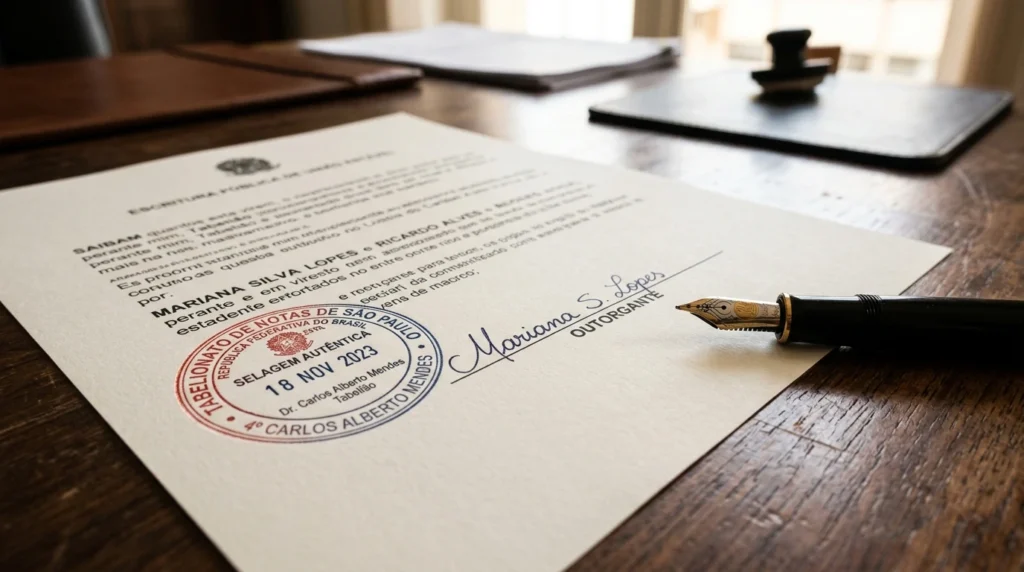
[IMAGE: Close-up of a civil partnership deed with a notary’s stamp and a pen. ALT-TEXT: “Civil partnership deed used by foreigners to obtain residency in Brazil.” FORMAT: WebP]
Frequently Asked Questions About Common-Law Marriage for Foreigners
What is a common-law marriage for foreigners?
It is the legal recognition of a public and long-term cohabitation between a foreign national and a Brazilian citizen or resident, with the aim of forming a family. In the context of immigration, it serves as the basis for a residence permit for family reunification, which is processed by the Federal Police and provided for in the Immigration Law.
How does a foreign national prove a stable relationship when applying for a residence permit?
The strongest evidence is a notarized civil partnership agreement. If such a document does not exist, the couple can provide evidence such as joint bank accounts, a lease in both their names, children they have in common, and witness statements. The more consistent the body of evidence, the lower the risk of challenges during the Federal Police investigation.
What is the difference between a common-law marriage and marriage for immigration purposes?
For residency purposes, both options confer the same basic family-based right. The difference lies in the evidence required. Marriage is directly proven by the marriage certificate. A common-law marriage depends on a body of evidence demonstrating cohabitation. Both apply to opposite-sex and same-sex couples, in accordance with Brazilian law.
Are same-sex couples entitled to residency based on a common-law marriage?
Yes. Brazilian law recognizes same-sex domestic partnerships as valid family relationships. Therefore, same-sex couples can apply for a residence permit on the grounds of family reunification under the same conditions as others. Proof of the relationship must meet the same criteria of public and long-term cohabitation. The process is the same with the Federal Police.
Is it worth formalizing a common-law marriage before applying for residency?
Yes, in most cases. A notarized civil union certificate is one of the forms of evidence most widely accepted by the Federal Police. Formalizing the relationship before filing the application strengthens the case and reduces the risk of additional requirements. Couples with thorough documentation tend to face fewer delays and, as a result, more predictable processing times. More details on family matters can be found in the section on family reunion and the foreign national's residence.
Why do foreign documents need an apostille and a translation?
Because the Federal Police requires that documents issued outside Brazil be legalized and understandable in Portuguese. The Hague Convention apostille certifies the authenticity of the foreign document. A certified translation ensures the legal validity of the content. Without these steps, certificates and proof of ties may be rejected, delaying the entire residency application.
Conclusion
A common-law marriage for foreigners is a legitimate and well-established path to residency in Brazil. The law treats spouses and domestic partners equally. What differs is the way in which the relationship is proven, not the right itself.
Experience shows that the success of an application depends on the quality of the documentation. Well-documented relationships, apostilled certificates, and certified translations reduce requirements and processing times. Weak cases, on the other hand, result in repeated suspensions and rework.
For families relocating internationally, understanding this foundation is key to the project’s success. Ensuring that dependents are properly registered prevents the expatriate’s life in Brazil from beginning amid uncertainty. Clarity regarding family ties is, ultimately, what ensures a smooth arrival.